The Art to Jump From One Place to Another
 Julien Vigroux performing parkour in a park | |
| Besides known as | PK[1] [ii] [3] |
|---|---|
| Focus | Obstacle passing |
| Country of origin | France |
| Creator | David Belle Yamakasi |
| Ancestor arts | Asian martial arts, athletics, gymnastics, obstacle courses |
| Descendant arts | Freerunning |
| Olympic sport | Not currently; IOC discussions underway[4] |
Parkour (French: [paʁkuʁ]) is an able-bodied training bailiwick in which practitioners (called traceurs) attempt to get from betoken A to bespeak B in the most fluid style possible, without assisting equipment and in the fastest and nearly efficient way possible. With roots in military obstacle course training and martial arts, parkour includes running, climbing, swinging, vaulting, jumping, plyometrics, rolling, and quadrupedal motility—any is suitable for a given state of affairs.[5] [six] Parkour is an activeness that tin can be practiced alone or with others, and is usually carried out in urban spaces, though it can be done anywhere.[7] [viii] It involves seeing one's surroundings in a new way, and envisioning the potential for navigating it by motility effectually, across, through, over and under its features.[9] [x]
Although practitioners of Parkour often perform flips and other acrobatic movements, these are not considered a office of Parkour proper.[11]
The do of similar movements had existed in communities around the earth for centuries,[12] notably in Africa[13] and China,[14] the latter tradition (qinggong) popularized by Hong Kong action movie house (notably Jackie Chan) during the 1970s to 1980s.[14] [15] [16] Parkour as a type of movement was later established by David Belle when he and others founded the Yamakasi in the 1990s and initially called information technology l'art du déplacement .[17] [eighteen] The subject was popularised in the 1990s and 2000s through films, documentaries, video games, and advertisements.[12] [xix] [xx]
Etymology [edit]
The word parkour derives from parcours du combattant (obstacle course), the archetype obstruction course method of military training proposed by Georges Hébert.[21] [22] [23] Raymond Belle used the term " les parcours " to encompass all of his training including climbing, jumping, running, balancing, and the other methods he undertook in his personal athletic advancement.[24] His son, David, further developed his father's methods and accomplished success as a stuntman, and i mean solar day on a moving picture set showed his 'Speed Air Human being' video to Hubert Koundé. Koundé suggested he change the "c" of " parcours " to a "grand" because information technology was stronger and more dynamic, and to remove the silent "south" for the same reason, forming "parkour".[25]
A practitioner of parkour is chosen a traceur, with the feminine class beingness traceuse.[5] They are nouns derived from the French verb tracer, which normally means "to trace", as in "tracing a path", in reference to drawing.[26] The verb tracer used familiarly ways: "to bustle up".[27] The term traceur was originally the name of a parkour group headed by David Belle which included Sébastien Foucan and Stéphane Vigroux.[28]
A jam refers to a meeting of traceurs, involving grooming lasting anywhere from hours to several days, often with people from different cities. The start parkour jam was organised in July 2002 by Romain Drouet, with a dozen people including Sébastien Foucan and Stéphane Vigroux.
History [edit]
Origins [edit]
The practice of similar movements have existed in various communities around the world for centuries prior to the foundation of a parkour movement, which was influenced past these earlier traditions.[12] [15] [xvi] Such athletic traditions had existed among various indigenous tribes in Africa for centuries.[13] A like subject area in Chinese culture is qinggong, a Chinese martial arts preparation technique that also dates dorsum centuries. It was notably taught at the Peking Opera Schoolhouse in the 20th century; the schoolhouse's about notable students are the 7 Picayune Fortunes, including Sammo Hung and nearly famously Jackie Chan, providing a basis for their acrobatic stunt work in Hong Kong activity cinema from the 1970s onwards.[14] [15] [16]
Georges Hébert [edit]
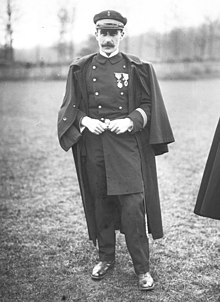
In Western Europe, a forerunner of parkour was developed by French naval officeholder Georges Hébert, who earlier World War I promoted athletic skill based on the models of ethnic tribes he had met in Africa.[thirteen] He noted, "their bodies were fantabulous, flexible, nimble, skillful, enduring, and resistant simply yet they had no other tutor in gymnastics but their lives in nature."[xiii] His rescue efforts during the 1902 eruption of Mount Pelée on Saint-Pierre, Martinique reinforced his belief that athletic skill must be combined with courage and altruism.[thirteen] Hébert became a physical education tutor at the college of Reims in France. Hébert set up a "méthode naturelle" (natural method) session consisting of x fundamental groups: walking, running, jumping, quadrupedal movement, climbing, balancing, throwing, lifting, self-defence, and swimming. These were intended to develop "the 3 main forces": energetic (willpower, courage, coolness, and firmness), moral (benevolence, assistance, honour, and honesty), and physical (muscles and breath).[29] During World War I and Globe War Two, teaching connected to aggrandize, becoming the standard organisation of French military educational activity and training. Inspired by Hébert, a Swiss architect developed a "parcours du combattant"[30]—military obstacle class—the outset of the courses that are now standard in military training and which led to the evolution of civilian fitness trails and confidence courses.[thirteen]
Raymond and David Belle [edit]
Born in 1939 in Vietnam, Raymond Belle was the son of a French md and Vietnamese mother. During the First Indochina War, his father died and he was separated from his mother, after which he was sent to a military machine orphanage in Da Lat at the age of seven. He took it upon himself to railroad train harder and longer than everyone else in order never to exist a victim. At night, when everyone else was asleep, he would be outside running or climbing copse. He would use the military obstacle courses in hole-and-corner, and also created courses of his own that tested his endurance, strength, and flexibility. Doing this enabled him not only to survive the hardships he experienced during his childhood, but also somewhen to thrive. Subsequently the Battle of Dien Bien Phu in 1954, he returned to France and remained in military pedagogy until the age of 19, when he joined the Paris Burn Brigade, a French Army unit of measurement.[12] [31] [32]
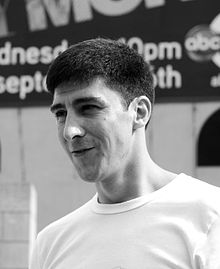
Raymond'south son, David Belle, was born in 1973. He experimented with gymnastics and athletics merely became increasingly disaffected with both school and the sports clubs. As he got older, he claims to have to read (as-yet-unconfirmed) newspaper clippings that told of his male parent's exploits and was increasingly curious about what had enabled his father to accomplish these feats. Through conversations with his father, he realised that what he really wanted was a means to develop skills that would be useful to him in life, rather than merely training to boot a ball or perform moves in a padded, indoor environment.[12] [24]
Through conversations with his male parent, David learned virtually this way of preparation that his father chosen "parcours". He heard his father talk of the many repetitions he had done in social club to find the best mode of doing things. He learned that for his father, training was not a game just something vital which enabled him to survive and to protect the people he cared virtually. David realised that this was what he had been searching for, so he began training in the aforementioned style. After a time, he plant it far more important to him than schooling and he gave up his other commitments to focus all his time on his training.[24]
Yamakasi [edit]
David initially trained on his own, and afterwards moving to Lisses, establish other immature men (including his cousins) who had like desires, and they began to train together.[1] The group eventually included David Belle, Sébastien Foucan, Châu Belle Dinh, Williams Belle, Yann Hnautra, Laurent Piemontesi, Guylain Due north'Guba Boyeke, Malik Diouf, and Charles Perrière. The group began calling themselves the Yamakasi, from the Lingala ya makási, meaning strong in one's person, or "strong homo, strong spirit"[33] (come across § Name and split below).
The group drew inspiration from Asian culture and Asian martial arts, notably the acrobatics of Jackie Chan such every bit qinggong displays in his Hong Kong action films,[xv] [34] [16] and the training philosophy of Bruce Lee,[35] considering the latter to be the "unofficial president" of their group.[xvi] The group also was influenced by the Japanese shōnen manga and anime series Dragon Ball, in which the heroes attained extraordinary abilities through hard work, also every bit the martial arts films of Belgian actor Jean-Claude Van Damme.[16]
Subject [edit]
The group put themselves through challenges that forced them to observe the physical and mental strength to succeed. Examples included training without food or water, or sleeping on the floor without a blanket to learn to endure the cold.[36] For example, no one in the grouping was permitted to be late for training, as information technology would concur back the whole grouping. If any member completed a challenge, anybody else had to exercise the same matter.[37] During their training, no 1 was allowed to complain or be negative. Few excuses were allowed. For instance, if someone claimed that his shoes were too worn out in to make a jump, he had to do it anyway, even if it meant doing the jump barefoot.[38] At the same time, everyone was required to have cognition of their own limits.[39]
Respecting one'south health and physical well-being was one of the foundations of the grouping. If whatever member hurt himself during or afterwards the execution of a movement, the movement was deemed a failure. A movement executed only once was not considered an achievement; only with repetition was the challenge complete. Every motility had to exist repeated at least 10 times in a row without the traceur having to push his limits or sustaining whatever injury. If whatever mistake was made by any traceur in the grouping anybody had to commencement all again.[37]
Humility was an important principle.[39] No traceur was immune to feel superior to someone else, for example, past executing a movement only to show off in forepart of someone who could not perform the motility. If whatever traceur in the group claimed that he had completed a difficult and unsafe challenge that should not be attempted unaided, he had to show his claims by doing the challenge again. Anyone who lied violated the principle of humility.[37]
To join the group, new members had to be recommended by an existing member and then pass tests to evaluate their motivation for joining.[38] Despite the huge accent on the collective, each traceur had to progress and develop independently—"to create the means to be yourself"[40]—and there was a consummate trust within the grouping.[39] Every traceur was to encourage the others and prove confidence through their behaviour.[41] If a member violated the principles, the group could meet without the offending person to discuss diverse punishments. Anyone deemed unsuitable could be temporarily or even permanently banned from the group in order to uphold its disciplines and values.[42]
Proper name and split [edit]
In 1997, David Belle'south brother Jean-François invited the group to perform for the public in a fireman show in Paris.[33] For the performance, the group named themselves Yamakasi, from the Congolese Lingala ya makási, pregnant strong in one's person, or "strong man, strong spirit". Sébastien Foucan also invented a name for what they were doing: "fifty'art du déplacement " (French for "the art of movement").[33] The fire fighter performance caused both positive and negative attending. Some members of the group were concerned how the public would view their discipline since the operation did non demonstrate all aspects of it, such as their hard preparation and their values and ethics. Jean-François also sent pictures and video of the group to a French Television program, and the popularity of parkour began to increase. A series of television programmes in various countries subsequently featured video footage of the group, and they began to become more requests for performances. During this time, conflicting interests arose within the grouping. Sébastien Foucan wanted to teach more than rather than to train more, and David Belle had the appetite to become an player. David and Sébastien chose to leave the group, and used the name "parkour" to describe their action (see § Etymology to a higher place). The seven remaining Yamakasi members connected to use the term l'fine art du déplacement [12] [43] (meet § Derivative terminologies and disciplines below).
Organizations [edit]
International parkour organizations include the Earth Freerunning and Parkour Federation, established in 2007, who take worked with MTV to produce parkour-related shows.[44]
International Gymnastics Federation (FIG) added parkour as one of their disciplines in 2017, despite much opposition, including the establishment of Parkour World to stand for various national organizations in opposition to the gymnastics organization.[45] [46] [47] The FIG plan includes Speed-Run (Sprint) and Freestyle events. The starting time event in the FIG Parkour World Loving cup was held on six–8 April 2018.[48] The beginning Parkour World Championships was scheduled to take place at Hiroshima on 3–v Apr 2020, only was postponed every bit a effect of the COVID-nineteen pandemic.[49] [50] [51] Parkour is expected to debut at the 2022 World Games.[52]
Philosophy [edit]

A beginner takes a leap in Seattle's Freeway Park under the guidance of experienced practitioners (2012).
According to Williams Belle, the philosophies and theories behind parkour are an integral aspect of the art, one that many not-practitioners have never been exposed to. Belle says he trains people because he wants it "to be alive" and "for people to utilise it".[53] Châu Belle explains it is a "type of freedom" or "kind of expression"; that parkour is "but a state of heed" rather than a set of actions, and that it is nigh overcoming and adapting to mental and emotional obstacles likewise as physical barriers.[53] Traceur Dylan Baker says, "Parkour also influences one's thought processes by enhancing self-confidence and disquisitional thinking skills that allow one to overcome everyday physical and mental obstacles".[53] [54] [55] A report by Neuropsychiatrie de l'Enfance et de l'Boyhood (Neuropsychiatry of Babyhood and Adolescence) in French republic found traceurs seek more excitement and leadership situations than gymnasts do.[56]
Academic enquiry on parkour has tended to draw how parkour provides a novel way of interacting with the urban environment that challenges the use and meaning of urban space, metropolitan life, and embodiment.[57]
A newer convention of parkour philosophy has been the idea of "man reclamation".[58] Andy Tran of Urban Evolution clarifies it as "a means of reclaiming what it means to be a homo. It teaches us to move using the natural methods that we should take learned from infancy. It teaches us to bear on the world and interact with it, instead of being sheltered by it."[58] Another traceur[ who? ] writes, "It is as much equally a part of truly learning the physical fine art equally well as being able to master the movements; it gives you the ability to overcome your fears and pains and reapply this to life, as you must be able to command your mind in guild to master the fine art of parkour."[59]
Competition [edit]
A campaign was started on 1 May 2007 by the Parkour.NET portal to preserve parkour's philosophy against sports contest and rivalry.[60] [61] In the words of Erwan Le Corre, "Competition pushes people to fight against others for the satisfaction of a oversupply and/or the benefits of a few business people by irresolute its mindset. Parkour is unique and cannot be a competitive sport unless information technology ignores its altruistic core of self-development. If parkour becomes a sport, it will exist difficult to seriously teach and spread parkour as a not-competitive action. And a new sport will be spread that may exist called parkour, but that won't hold its philosophical essence anymore."[60] Ruddy Balderdash'south sponsored athlete for parkour, Ryan Doyle, has said, "Sometimes people ask, 'Who is the best at parkour?' and it is because they don't empathise what Parkour is; 'Who is the best?' is what you would say about a sport, and parkour is not a sport—it is an art, it'southward a bailiwick. That's similar saying, 'What's the best song in the world?'"[62] This seems to be the consensus among many professional person traceurs who view parkour as a lifestyle more as a set of tricks, as has been popularised by YouTube and nigh media exposure.[ citation needed ]
In that location are competitions that use parkour as the primary influence for formatting and judging criteria. Sport Parkour League's "North America Parkour Championships" hosts a series of local and regional qualifier events which culminate in a terminal event in Vancouver, B.C.[63] Red Bull'south Art of Motion event[64] is the longest running and highest profile professional freerunning competition.
David Belle [edit]
In his 2009 book Parkour, David Belle stressed that the almost important aspect of parkour is not the physical movements, but rather the practitioner's mentality and understanding of its principles. "When young trainees come to see me and give me videos telling me to check out what they are doing, I merely accept the tape and throw it abroad. What I'1000 interested in is what the guy's got in his head, if he has self-confidence, if he masters the technique, if he has understood the principles of parkour. I just can't bargain with guys who exercise Parkour because they saw videos on the Internet and thought it was kinda cool and want to do fifty-fifty meliorate."[65] Further, he states the importance of traceurs being aware of their abilities and limitations, and developing in their own way. "When a young person asks me, 'Tin can you show me how to do this?' I just respond, 'No, I am going to evidence you lot how I practise information technology. Then, you'll have to acquire with your own technique, your own way of moving, your mode, your abilities and your limitations. You are going to larn to exist yourself, not someone else along the mode.'"[66]
The philosophy of parkour has been compared to that of martial arts.[67] In an interview with The New Yorker, David Belle acknowledges the influence, "At that place's a quote past Bruce Lee that'southward my motto: 'In that location are no limits. There are plateaus, only you must not stay in that location, you must become beyond them. A man must constantly exceed his level.' If you're not improve than y'all were the 24-hour interval earlier, then what are yous doing—what'southward the point?"[xxx] In an interview with the press, Belle explained that parkour is a training method for warriors. "So many people try to train easy—'Come practice parkour! Information technology's really cool!' Simply if tomorrow I made you lot do real training, you lot would finish up crying. That's what you demand to know: y'all are going to weep, you lot are going to drain and you are going to sweat like never before."[68] In his book, Belle also quotes his father Raymond, "If two roads open earlier you, always take the about difficult one. Considering you know you can travel the easy one."[69]
Belle is an influential proponent of field of study and control in parkour, maxim, "Precision is all well-nigh existence measured," and going on to describe parkour as an art that requires huge amounts of repetition and do to chief.[70] "With parkour, I oft say, 'One time is never'. In other words, someone can manage a jump one time but information technology does non mean anything. It can be luck or chance. When you make a spring, you lot have to practice it at least three times to be certain y'all can actually exercise it. It's an unavoidable rule. Do information technology the hard manner and finish lying to yourself. When you come for preparation, y'all have to train. Fifty-fifty if information technology ways doing the same bound fifty or a hundred times."[66] To its founder, parkour is a method of self-refinement, used for learning to control and focus oneself.
Practice [edit]
Movement [edit]
A practitioner performing a wall run
While there is no official list of "moves" in parkour, the style in which practitioners move oft sets them apart from others,[half-dozen] and in that location are a number of named movements that are characteristic,[17] for example:[71] [72] [73]
- "Parkour roll": Rolling to absorb impacts from larger drops, moving diagonally over a shoulder to convert momentum from vertical to horizontal.
- "Precision bound": Jumping and landing accurately with the feet on small or narrow obstacles.
- "Arm jump": Jumping and landing feet-first on a vertical surface, catching the horizontal top with the hands.
- "Wall run": Running toward a high wall and so jumping and pushing off the wall with a human foot to accomplish the tiptop of the wall.
- "Climb up": Moving from a position hanging from a wall-meridian or ledge, to standing on the top or vaulting over to the other side.
Equipment [edit]

A traceuse vaults a railing.
Parkour is practiced without traditional equipment, though items such as bars, walls, and boxes establish in the environment in which the parkour is being practiced in, are utilised to improve navigate the area. Practitioners normally train wearing lite, non-restrictive casual wearable.[74] [75] Traceurs who wear gloves are rare—blank hands are considered better for grip and tactile feedback.[76] [77] Low-cal running shoes with good grip and flexibility are encouraged considering they allow for more than natural and fluid movements. Practitioners frequently use minimalist shoes, sometimes every bit a progression to blank feet, for ameliorate sensitivity and remainder, while others prefer more cushioning for better absorption of impacts from large jumps.[78] Barefoot training is done past some for movement competency without gear—David Belle noted that "bare feet are the all-time shoes."[79] Various sneaker manufacturers have developed shoes specifically for parkour and freerunning. Many other companies effectually the globe have started offering clothing targeted at parkour.[80]
Risks [edit]
Trespassing [edit]

Traceurs in Lisses re-painting a wall and repairing shoe scuff marks from parkour

Parkour is non widely proficient in dedicated public facilities. Although efforts are being made to create places for information technology, many traceurs practise not similar the idea, every bit it is contradictory to parkour's values of adaptation, creativity, and freedom.[81] Traceurs practice parkour in both rural and urban areas such every bit gyms, parks, playgrounds, offices, and abased structures. Concerns take been raised regarding trespassing, harm of property,[82] and use of inappropriate places such as cemeteries.[83] Many parkour organizations effectually the world support the Leave No Trace initiative, an urban version of the outdoor conservation ethic created by the Seattle nonprofit Parkour Visions in 2008, promoting safety, respect for the spaces used and their other users, and sometimes includes picking upwardly rubbish to leave areas in amend condition than they were found.[84] [85] [86] [87] [88]
Injuries and deaths [edit]
Concerns have been raised by law enforcement and burn down and rescue teams about the risks inherent in jumping off loftier buildings.[89] They debate that practitioners are needlessly risking damage to both themselves and rooftops by practicing at height, with police forces calling for practitioners to stay off the rooftops.[82] [90] [91] Some practitioners of parkour agree that such behaviour should exist discouraged.[90] [92] [93] [94]
Because parkour philosophy is nigh learning to command oneself in interaction with the surround, many parkour experts consider serious injury show of the traceur'south failure to follow the precepts of the subject field, specifically, knowing 1's limitations. Daniel Ilabaca, co-founder of the World Parkour and Freerunning Federation, said, "Thinking you're going to fail at something gives you a higher risk of doing simply that. Committing to something you're thinking or knowing you will land gives you a higher chance of landing or completing the task."[95] On biomechanical grounds, studies institute parkour landing techniques issue in lower landing forces in comparison with traditional sport techniques.[96] [97] In a survey of parkour-related emergency section visits in the Us between 2009 and 2015, most injuries were reportedly caused past landing or from striking objects.[98]
American traceur Mark Toorock said injuries are rare "because participants rely not on what they can't command—wheels or the icy surfaces of snowboarding and skiing—but their ain hands and feet," but Lanier Johnson, executive director of the American Sports Medicine Institute, noted that many of the injuries are not reported.[99]
Impact [edit]
Initially featured in films of French director/producer Luc Besson, parkour was kickoff introduced to the British public by the BBC One TV aqueduct trailer Rush Hour in April 2002. It featured David Belle leaping across London'due south rooftops from his office to home, in an attempt to take hold of his favourite BBC program,[100] and captured the imagination of many viewers, especially when they learned no special effects or wires were used.[101] This advert, along with others for Coca-Cola, Nike, and Toyota, had a big-scale impact on public awareness of parkour.[17] [102]
The cosmos of parkour show-reels and documentaries has been crucial to the spread of parkour, and is common in the parkour community.[12] [43] Jump London is a 2003 documentary explaining some of the groundwork of parkour, culminating with Sébastien Foucan, Johann Vigroux, and Jérôme Ben Aoues demonstrating their parkour skills. Leap London inverse the presence of parkour in the UK almost overnight and is widely credited for inspiring a new generation of traceurs.[57] It was followed by Bound Britain in 2005. Both Jump films were shown in more than 80 countries, thereby introducing the discipline and its philosophy to an unprecedented global audience. Both films have been cited by numerous practitioners equally their motivation for taking upwardly the discipline.
The Australian version of 60 Minutes broadcast a segment nigh parkour on xvi September 2007, featuring Foucan and Stephane Vigroux.[103]
Parkour is non defined by a gear up of rules or guidelines, a feature which has proven particularly attractive to young people, allowing them to explore and appoint in the activity on their own terms. Information technology tin can be hands accustomed by all cultures as a means of personal expression and recreation.[104] For instance, in 2010 The New York Times published a short video featuring three young men from the Gaza Strip who were active members of the parkour community.[105] In 2014, the BBC covered youth parkour participation in Jammu and Kashmir. Zahid Shah founded the Kashmir Freerunning and Parkour Federation, finding hope in the non-violent discipline of parkour.[106]
Entertainment [edit]
Parkour has become a popular chemical element in action sequences, with film directors hiring parkour practitioners as stunt performers. The first director to do then was Luc Besson, for the motion picture Taxi two in 1998, followed by Yamakasi in 2001 featuring members of the original Yamakasi grouping, and its sequel Les fils du vent in 2004. Too in 2004, Besson wrote Commune thirteen, another feature motion-picture show involving advanced parkour hunt sequences, starring David Belle and Cyril Raffaelli,[107] [108] followed by the sequel District 13: Ultimatum in 2009 and remade in English language as Brick Mansions in 2014.
In 2006 the film Casino Royale featured Sébastien Foucan in a chase taking identify early in the movie, sparking renewed media involvement in parkour.[xxx] Along with The Bourne Ultimatum (2007), Casino Royale is credited with starting a new wave of Parkour-inspired stunts in Western moving picture and television.[109] Parkour was prominent in Live Free or Die Difficult (2007),[110] once again with stuntman/actor Cyril Raffaelli, and Prince of Persia: The Sands of Time (2010), choreographed by David Belle.[111] Several films as well Yamakasi are about thieves who utilise parkour, such as Breaking and Entering (2006),[107] [108] Run (2013),[112] and Tracers (2015). The 2011 pic Freerunner is about eight freerunners racing through a city for survival. The 2019 Netflix film 6 Secret featured several parkour scenes choreographed and performed by team Storror.[113] [114] Parkour also featured in Dhoom 3 (2013),[115] Bang Bang! (2014) and Aadhi (2018).[116]
Parkour is also featured on Television receiver. MTV's evidence Ultimate Parkour Challenge premiered equally a one-hour special in October 2009 starring the athletes of the World Freerunning & Parkour Federation. This was followed in May 2010 with a six-episode series of the aforementioned name. The athletes were Daniel Ilabaca, Tim Shieff, Ryan Doyle, Michael Turner, Oleg Vorslav, Ben Jenkin, Daniel Arroyo, Pip Andersen and Rex David. The programme format was a two-role weekly contest in dissimilar Southern California locations.[117]
Professional wrestler John Hennigan is a long-time practitioner of parkour and frequently incorporates it into his wrestling mode, with the WWE giving him the nickname "The Prince of Parkour".[118] [119] Role player Stephen Amell learned parkour at Tempest Academy in grooming for his part equally Oliver Queen in the television series Arrow,[120] and co-star Caity Lotz is also a practitioner.[121]
Modern video games frequently include aspects of parkour every bit major game-play elements. The Assassin's Creed serial makes heavy use of parkour movement (chosen freerunning in the game).[122] [123] [124] The Mirror's Edge games are heavily inspired by parkour, consisting entirely of efficiently moving effectually buildings, rooftops, and other obstacles.[125] [126] Brink introduced a parkour mechanic into a realistic first-person shooter.[127] Prince of Persia and Dying Light include a central parkour mechanic,[128] [129] while Crackdown and Crackdown ii include an emphasis on gripping and vaulting from ledges and protruding objects.[130] Tony Hawk's American Wasteland allows the grapheme to utilize several freerunning techniques while non on the skateboard.[131] Tron Development 's bones movements and gainsay were based on parkour and capoeira.[132]
Military machine training [edit]
Although parkour itself grew out of military obstacle-course training,[12] [31] it has go a split up discipline. After the attention that parkour received following the 2006 film Casino Royale, military forces around the globe began looking for means to incorporate elements from parkour into military grooming. A concrete trainer with the Majestic Marines trained with parkour practitioners with hopes of introducing some of their techniques to his own students.[133] Colorado Parkour began a project to introduce elements from parkour into the U.S. armed forces[134] and ane San Diego staff sergeant trained US Marines in parkour.[135]
Scientific research and applications [edit]
Studies have constitute that in exercises such every bit the standing long jump, depth jump, and vertical jump, parkour athletes outperform concrete educators,[ citation needed ] gymnasts, and power athletes.[136] Parkour training is peculiarly linked with the development of eccentric load resistance and jumping ability.
Studies and experiments have integrated parkour kinaesthetics into robotics.[137] [138] [139] [140]
Derivative terminologies and disciplines [edit]
In September 2003, Mike Christie'south documentary Jump London, starring Sébastien Foucan, was released. In the documentary, the term "freerunning" was used as an attempt to translate "parkour", in order to make information technology more appealing to the English-speaking audience.[141] Foucan decided to continue using the term "freerunning" to describe his discipline, to distinguish it from David Belle's methods.[142] [143]
The remaining seven Yamakasi members continued to utilize the term "l'art du déplacement ", besides not wanting to associate information technology too closely with parkour. Similar to Sébastien's freerunning, l'fine art du déplacement is less nearly the hard subject field of the original Yamakasi group; rather, information technology takes a participatory approach focused on making the instruction more accessible. David Belle kept the term "parkour", saying the group contributed to the development of it, but that his begetter was the source of his motivation and had verbally communicated this method only to him.[143]
Both parkour and freerunning embrace the ideas of overcoming obstacles and self-expression; in freerunning, the greater emphasis is on self-expression.[142] Although the differences between the disciplines are often hard to discern, practitioners tend to aspire to parkour and draw themselves as traceurs rather than every bit freerunners.[144]
See likewise [edit]
- Acrobatics
- Buildering
- Calisthenics
- Dérive – a philosophy and technique of rapid, serendipitous movement through mostly urban environments
- Obstacle racing
- Platform game
- Qinggong – Chinese martial arts techniques
- Street conditioning
- Urban exploration
- Woggle hopping
- World Chase Tag
References [edit]
- ^ a b "Actor David Belle Biography". David Belle. Archived from the original on 20 October 2014. Retrieved 22 May 2014.
- ^ "3RUN Story". 3run.co.great britain. half dozen December 2012. Archived from the original on 6 March 2014. Retrieved 22 May 2014.
- ^ "About the Tapp Brothers". LearnMoreParkour.com. Archived from the original on 31 March 2014. Retrieved 22 May 2014.
- ^ "PARKOUR – A Immature SPORT WITH OLYMPIC AMBITIONS". European Olympic Committees. Archived from the original on 26 October 2016. Retrieved 15 December 2021.
- ^ a b Ferrari, Matthew (7 May 2010). "From 'Play to Brandish': Parkour as Media-Mimetics or Nature Reclamation?". FlowTV, vol xi, lokaliseret den 01-04-2011 på. Archived from the original on v November 2019. Retrieved xvi January 2020.
- ^ a b De Feitas, Elizabeth (2011). "Parkour and the Congenital Surround: Spatial Practices and the Plasticity of School Buildings". Journal of Curriculum Theorizing. 27 (three): 209. Archived from the original on 2 April 2015. Retrieved ane March 2015.
- ^ Rawlinson, Christopher; Guaralda, Mirko (11 September 2012). "Chaos and creativity of play: designing emotional engagement in public spaces". In Out of Control: 8th International Briefing on Design and Emotion. Key Saint Martins College of Arts and Design, London. ISBN9780957071926. Archived from the original on fourteen May 2013. Retrieved 16 March 2013.
- ^ Brunner, C. (2010). "Nice-looking obstacles: Parkour equally urban practice of deterritorialization" (PDF). AI & Society. 26 (2): 143–152. doi:ten.1007/s00146-010-0294-2. S2CID 11017425. Archived (PDF) from the original on 27 August 2020. Retrieved eleven June 2019.
- ^ Rawlinson, Christopher; Guaralda, Mirko (27 Apr 2011), "Play in the city: Parkour and architecture", The First International Postgraduate Conference on Engineering, Designing and Developing the Built Surroundings for Sustainable Wellbeing, Queensland Academy of Technology, Brisbane, Australia, ISBN9780980582741, archived from the original on 14 May 2013, retrieved 16 March 2013
- ^ Ameel, L.; Tani, Southward. (2012). "Everyday aesthetics in action: Parkour Eyes and the beauty of physical walls". Emotion, Space and Lodge. 5 (3): 164–173. doi:x.1016/j.emospa.2011.09.003.
- ^ Kidder, Jeffrey (2017). Parkour and the City. New Jersey: Rutgers University Printing. p. 146. ISBN978-0813571980. "flips: ... "However they are usually designated as a function of freerunning, non of Parkour."
- ^ a b c d eastward f g h Angel, pp. 17–xx
- ^ a b c d e f Artful Dodger. "Georges Hebert and the Natural Method of Physical Culture". Archived from the original on 23 March 2005. Retrieved 2 July 2013.
- ^ a b c Lin, Jeannie (10 June 2012). "What I'm Researching Now: Qing Gong & Freerunning". Jeannie Lin . Retrieved 27 March 2021.
- ^ a b c d Stratford, Elaine (2014). Geographies, Mobilities, and Rhythms over the Life-Class: Adventures in the Interval. Routledge. p. 79. ISBN978-1135117429. Archived from the original on 3 June 2020. Retrieved 14 March 2019.
- ^ a b c d east f Affections, Julie (16 June 2016). Breaking the Jump: The Secret Story of Parkour's High Flying Rebellion. Aurum Press. ISBN978-1-78131-554-5. Archived from the original on ii July 2021. Retrieved 27 March 2021.
- ^ a b c "Parkour History". Parkour Generations. 22 August 2014. Archived from the original on 8 December 2015. Retrieved 2 December 2015.
- ^ "Interview with David Belle". YouTube. Archived from the original on 14 December 2015. Retrieved 2 December 2015.
- ^ Belle, David (2006). "Entrevista com David Belle (OSRAM 2006)" [Interview with David Belle (OSRAM 2006)] (Interview). Archived from the original on eight July 2013. Retrieved 10 Feb 2013.
- ^ Atkinson, M. (2009). "Parkour, Anarcho-Environmentalism, and Poiesis". Journal of Sport & Social Issues. 33 (2): 169–194. doi:10.1177/0193723509332582. S2CID 146783270.
- ^ Russell, Matthew. "English welcome – Parkour Worldwide Association". Archived from the original on 8 May 2005. Retrieved 12 May 2007.
- ^ "PAWA statement on Freerunning". 23 February 2006. Archived from the original on 27 September 2007. Retrieved 12 May 2007.
- ^ "The name Parkour, elementary question". Archived from the original on 27 September 2007. Retrieved 12 Apr 2007.
- ^ a b c Belle, pp. 31–seventy
- ^ Affections, p. 37.
- ^ "Portail lexical – Définition de tracer" (in French). Archived from the original on 24 Baronial 2011. Retrieved 28 August 2007.
- ^ (Populaire) Filer, se dépêcher. or to run (go) fast (to leave in a hurry) → (intransitive, breezy) to leave, to get going, (reflexive) to haste, to bustle up → (idiomatic, dated) Hurry up; make haste.
- ^ "An Interview With Stephane Vigroux". 27 January 2009. Archived from the original on 30 October 2021. Retrieved 22 May 2014 – via YouTube.
- ^ "Georges Hébert – la methode naturalle" (in French). INSEP – Musée de la Marine. Archived from the original (JPG) on 18 July 2006. Retrieved 22 September 2007.
- ^ a b c Wilkinson, Alec (16 April 2007). "No Obstacles". The New Yorker. Archived from the original on eleven October 2007. Retrieved xiv October 2007.
- ^ a b Belle, pp. 23–30
- ^ "Raymond Belle'south biography". Original French biography sourced from 'Allo Dix-Huit', the magazine of the Parisian pompiers. Parkour.NET. 17 Feb 2006. Archived from the original on 17 February 2006. Retrieved 29 Nov 2007.
- ^ a b c Angel, p. 35.
- ^ Hunt, Leon; Wing-Fai, Leung (2010). E Asian Cinemas: Exploring Transnational Connections on Moving picture. I.B. Tauris. ISBN978-0857712271. Archived from the original on 3 June 2020. Retrieved 14 March 2019.
- ^ "Parkour History". Parkour Generations. Archived from the original on 31 May 2019. Retrieved 13 March 2019.
- ^ Affections, p. 23
- ^ a b c Belle and Perriére, p. 43
- ^ a b Belle and Perriére, p. 42
- ^ a b c Belle and Perriére, p. 46
- ^ Belle and Perriére, p. 53
- ^ Belle and Perriére, p. 47
- ^ Belle and Perriére, p. 44
- ^ a b Belle, pp. 71–79
- ^ History of WFPF Archived 14 July 2018 at the Wayback Machine wfpf.com
- ^ "Fig-Gate: The Great Parkour Scandal". accessparkour.com. 11 May 2017. Archived from the original on 14 July 2018. Retrieved 14 July 2018.
- ^ "Denmark add vox to opposition of FIG's move into parkour". insidethegames.biz. 1 June 2017. Archived from the original on xiv July 2018. Retrieved 14 July 2018.
- ^ "Parkour Globe officially launches every bit FIG row continues". insidethegames.biz. 4 August 2017. Archived from the original on 14 July 2018. Retrieved 14 July 2018.
- ^ "7 days to go till first FIG Parkour World Loving cup". International Gymnastics Federation. 30 March 2018. Archived from the original on 14 July 2018. Retrieved 14 July 2018.
- ^ "Main decisions from the 18th FIG Council in Istanbul". International Gymnastics Federation. xiv May 2018. Archived from the original on 14 July 2018. Retrieved 14 July 2018.
- ^ "Hiroshima to host 1st Parkour Earth Championships in 2020". Archived from the original on 29 August 2019. Retrieved 29 August 2019.
- ^ "First FIG Parkour World Championships postponed". Archived from the original on x Jan 2022. Retrieved 17 August 2020.
- ^ Gymnastics at the Earth Games Archived 9 May 2019 at the Wayback Auto theworldgames.org
- ^ a b c Belle, Châu; Belle, Williams; Hnautra, Yann and Daniels, Marking (director). Generation Yamakasi (TV-Documentary) (in French). French republic: France ii. Retrieved 25 August 2007.
- ^ Mai, Jeffy (14 Apr 2008). "Students on campus are mastering parkour, an art of cocky-awareness and body command". Archived from the original on 25 September 2010. Retrieved 19 April 2008.
- ^ Kalteis, Andreas (2006). Parkour Journeys – Preparation with Andi (DVD). London: Catsnake Studios.
- ^ Cazenave, N. (2007). "La pratique du parkour chez les adolescents des banlieues: Entre recherche de sensation et renforcement narcissique". Neuropsychiatrie de l'Enfance et de l'Adolescence. 55 (3): 154–159. doi:x.1016/j.neurenf.2007.02.001.
- ^ a b Gilchrist, Paul; Wheaton, Belinda (30 July 2012). Hutchins/Rowe (ed.). New Media Technologies in Lifestyle Sport. Digital Media Sport: Applied science and Power in the Network Order. Archived from the original on 10 January 2022. Retrieved 8 September 2013.
- ^ a b "2 Theories on Parkour Philosophy". Parkour Northward America. 7 September 2007. Archived from the original on 12 July 2012. Retrieved 16 April 2008.
- ^ "Parkour History". Urban bailiwick. Archived from the original on 17 July 2011. Retrieved v January 2015.
- ^ a b "Keeping parkour rivalry-costless : JOIN IN !". Parkour.Internet. 1 May 2007. Archived from the original on xiii July 2007. Retrieved 11 May 2007.
- ^ Bignell, Paul; Precipitous, Rob (22 Apr 2007). "'Jumped-up' plan to stage world competition sees complimentary runners falling out". The Contained. London. Archived from the original on 1 January 2008.
- ^ "Ryan Doyle – Parkour Training Jam". Archived from the original on 30 October 2021. Retrieved 22 May 2014 – via YouTube.
- ^ "Archived copy". Archived from the original on 7 August 2020. Retrieved 24 June 2020.
{{cite web}}: CS1 maint: archived copy as title (link) - ^ "Series Stops". www.redbull.com. Archived from the original on 26 June 2020. Retrieved 24 June 2020.
- ^ Belle, p. 58
- ^ a b Belle, p. 59
- ^ Green, Rob. "Bruce Lee and the Philosophy of Parkour". WorldWideJam.television set. Archived from the original on 23 July 2011. Retrieved i February 2011.
- ^ Cine parkour, p. 22
- ^ Belle, p. 27
- ^ "David Belle – Parkour". 16 July 2011. Archived from the original on 30 October 2021. Retrieved 22 May 2014 – via YouTube.
- ^ Murray, Joseph B (2010), Knowing Obstacles: Urban Dialogues in Parkour Practice (PDF) (Doctoral dissertation), Central European University, archived (PDF) from the original on 13 December 2013, retrieved 16 March 2013
- ^ McLean, C. R.; Houshian, Due south.; Pike, J. (2006). "Paediatric fractures sustained in Parkour (free running)". Injury. 37 (8): 795–797. doi:10.1016/j.injury.2006.04.119. PMID 16806217.
- ^ Chow, B. D. V. (2010). "Parkour and the critique of ideology: Turn-vaulting the fortresses of the urban center". Periodical of Trip the light fantastic toe and Somatic Practices. 2 (2): 143–154. doi:10.1386/jdsp.2.2.143_1.
- ^ "What Should I Wear for parkour?". americanparkour.com. 6 November 2005. Archived from the original on 3 Feb 2009. Retrieved 21 Apr 2007.
- ^ "Is there whatever equipment cost, membership fee, or exclusive conditions required for my child to practice Parkour?" (PDF). washingtonparkour.com. 2008. Archived from the original (PDF) on 8 March 2010. Retrieved four Apr 2008.
- ^ Arnold, Tiffany (28 September 2009). "Parkour: All in a twenty-four hours's training". Herald Mail. Archived from the original on 3 February 2014. Retrieved 25 July 2010.
- ^ Coin-Coutts, Sophia (23 Feb 2009). "You might as well bound". The National. Abu Dhabi Media Visitor. Archived from the original on 26 February 2009. Retrieved 25 July 2010.
- ^ "ten All-time Parkour Shoes (2020) – Freerunning Shoes Reviewed". ParkourShoesGuide. xi June 2017. Archived from the original on 22 October 2019. Retrieved nineteen June 2017.
- ^ "David Belle – Parkour simples". YouTube. 16 March 2007. Archived from the original on 30 October 2021. Retrieved vii July 2007.
- ^ "Know Obstacles". Archived from the original on xiii May 2014. Retrieved 12 May 2014.
- ^ "American Parkour HotSpots Contest". 21 May 2008. Archived from the original on 14 April 2009. Retrieved thirteen June 2008.
- ^ a b Gloucestershire – Rooftop-jumping youths arrested Archived 13 February 2008 at the Wayback Machine. BBC. 31 January 2008. Retrieved 15 March 2008.
- ^ Gammell, Caroline (6 May 2008). "Gravestone vaulting teenagers condemned over YouTube stunt". The Daily Telegraph. London. Archived from the original on 8 June 2008. Retrieved xiii June 2008.
- ^ "Go out No Trace Campaign (practice policy)". Archived from the original on 29 September 2012. Retrieved 18 April 2016.
- ^ Bafford, Tenedra (June 2013). "Without a Trace". Vertical Floor Magazine. Archived from the original on 27 Apr 2016. Retrieved 18 April 2016.
- ^ Puddle, Damien (23 July 2014). "New Zealand Parkour Vision and Values" (PDF). Archived (PDF) from the original on 21 Jan 2016. Retrieved 18 April 2016.
- ^ Hansen, Jimmy (1 March 2011). "Parkour at UGA". Archived from the original on 14 February 2012. Retrieved half dozen June 2011.
- ^ "American Parkour leaves Meridian Park when asked during national jam". American Parkour. Archived from the original on 27 September 2013. Retrieved seven November 2015.
- ^ Rawe, Julie (v April 2008). "Pupil Stuntmen". Time. Archived from the original on 12 June 2008. Retrieved 13 June 2008.
- ^ a b "Youths on Roofs". Your Local Guardian. 2 April 2008. Archived from the original on 12 June 2008. Retrieved nine August 2009.
- ^ Branum, Don (2 June 2008). "Parkour growing by leaps and bounds". Archived from the original on 5 July 2009. Retrieved 27 June 2008.
- ^ "Terrible Representation of Parkour and Freerunning". 13 June 2008. Archived from the original on 12 June 2008. Retrieved 13 June 2008.
- ^ Comenetz, Jacob (ix June 2005). "Running Through Life the Parkour Fashion". Deutsche Welle. Archived from the original on five July 2015. Retrieved 9 August 2009.
- ^ Parkour FAQ for Parents Archived 27 February 2017 at the Wayback Machine Pacific Northwest Parkour Association. 20 September 2008. Retrieved 17 August 2016.
- ^ "The Beachcomber : Parkour Legends: Daniel Ilabaca, Tim Shieff, and Oleg Vorslov". Beachcombermb.com. 17 March 2013. Archived from the original on vii August 2013. Retrieved 22 May 2014.
- ^ Puddle, Damien L.; Maulder, Peter Southward. (ane March 2013). "Ground Reaction Forces and Loading Rates Associated with Parkour and Traditional Drop Landing Techniques". Periodical of Sports Science and Medicine. 12 (1): 122–129. PMC3761764. PMID 24149735. Archived from the original on ten January 2022. Retrieved xiii December 2020.
- ^ Standing, Regan J.; Maulder, Peter Due south. (24 November 2015). "A Comparison of the Habitual Landing Strategies from Differing Drop Heights of Parkour Practitioners (Traceurs) and Recreationally Trained Individuals". Journal of Sports Scientific discipline and Medicine. fourteen (four): 723–731. PMC4657414. PMID 26664268. Archived from the original on 10 January 2022. Retrieved 13 Dec 2020.
- ^ Rossheim, ME; Stephenson, CJ (October 2017). "Parkour injuries presenting to United states of america emergency departments, 2009–2015". The American Periodical of Emergency Medicine. 35 (ten): 1503–1505. doi:10.1016/j.ajem.2017.04.040. PMID 28455090. S2CID 39559873.
- ^ Bane, Colin (8 January 2008). "Jump First, Inquire Questions Subsequently". The Washington Post. Archived from the original on 7 Nov 2012. Retrieved 19 April 2008.
- ^ "Unmissable new campaign for BBC Ane". BBC Press Role. 11 April 2002. Archived from the original on 5 Jan 2016. Retrieved two December 2015.
- ^ "BBC film'due south rooftop stunts 'real'". BBC News. 19 Apr 2002. Archived from the original on viii Dec 2015. Retrieved 2 December 2015.
- ^ Geyh, Paula (July 2006). "Urban Free Flow: A Poetics of Parkour". 1000/C Journal. ix (3). doi:10.5204/mcj.2635. Archived from the original on viii December 2015. Retrieved ii December 2015.
- ^ Hayes, Liz (16 September 2007). "Go Leap". 60 Minutes. Archived from the original on 26 December 2007. Retrieved 3 January 2008.
- ^ Thorpe, Holly (2013). International Review for the Sociology of Sport. Sage Publications Inc. p. v.
- ^ Sorcher, Sara (xiii October 2010). "Palestinian Parkour". The New York Times (video). Archived from the original on 14 March 2017. Retrieved 10 May 2017.
- ^ "Kashmir freerunning: Finding freedom in the fine art of parkour". BBC News. seven December 2014. Archived from the original on xviii November 2015. Retrieved one December 2015.
- ^ a b Barrera, Sandra (2 Jan 2007). "Parkour: Leaps of faith". Los Angeles Daily News. Archived from the original on 24 Feb 2007. Retrieved xi Dec 2007.
- ^ a b Bessaoud, Yuba; Delmar-Morgan, Alex (9 July 2006). "Focus: Look Mum, watch this!". The Times. London. Archived from the original on 29 August 2008. Retrieved three January 2008.
- ^ Szalai, Georg (28 August 2009). "Fremantle Pacts to Bring Parkour to Television Screens". Reuters. Archived from the original on 1 September 2009. Retrieved 23 September 2009.
- ^ Kornblum, Janet (3 December 2007). "'Expect, Ma, no hands' – or feet". Usa Today. Archived from the original on xx January 2008. Retrieved 7 December 2007.
- ^ Levy, Emanuel (2010). "Prince of Persia: Tackling Stunts and Parkour". Archived from the original on 7 May 2012. Retrieved 10 February 2013.
- ^ "Run (2013)". IMDb. Archived from the original on 17 January 2016. Retrieved 13 Jan 2016.
- ^ Gates, Christopher (13 December 2019). "The truth about those parkour scenes in 6 Underground". Looper.com. Archived from the original on 14 December 2019. Retrieved 22 January 2020.
- ^ "Ben Hardy talks defying gravity in Michael Bay'due south latest activity-packed thriller, 'half-dozen Underground' - Metro US". www.metro.us. 13 December 2019. Archived from the original on 10 January 2022. Retrieved 22 January 2020.
- ^ Lalwani, Vickey (18 Nov 2011). "Aamir Khan learns French technique of Parkour". Bombay Mirror; The Times of India. Archived from the original on 18 November 2011. Retrieved 24 November 2011.
- ^ George, Vijay (25 Jan 2018). "'Aadhi' packs a punch with parkour". The Hindu. Archived from the original on nine November 2020. Retrieved xxx Jan 2018.
- ^ "Ultimate Parkour Challenge". MTV. Archived from the original on 7 December 2013.
- ^ "John Morrison". WWE. Archived from the original on thirteen July 2016. Retrieved ane Dec 2011.
- ^ Adkins, Greg (31 January 2011). "It's good to be "Rex"". WWE. Archived from the original on five November 2015. Retrieved 31 January 2011.
- ^ Wickline, Dan (xviii June 2014). "Stephen Amell Back In Training For Arrow Flavour 3" Archived ix February 2015 at the Wayback Machine. Bleeding Cool Comic Volume, Movie, Tv News.
- ^ "Kick Ass Caity Lotz From MTV's Death Valley Talks Nigh Zombies, Parcour and Twilight'southward Jackson Rathbone". Daemon'south Tv. Archived from the original on eighteen September 2011. Retrieved 27 May 2016.
- ^ "Assassin's Creed (Xbox 360)". 28 November 2007. Archived from the original on i Dec 2007. Retrieved eleven December 2007.
Information technology's a adept start, an fantabulous gratis-roaming adventure with some of the best apply of parkour yet.
- ^ Pearson, Ryan (16 November 2007). "Review: 'Assassin'south Creed' Not Quite Perfect". Fox News Channel. Archived from the original on 4 March 2009. Retrieved 23 September 2009.
Leave it to the French to bring usa the get-go parkour video game
- ^ P., Andrew (January 2008). "Review of Assassin's Creed". Electronic Gaming Monthly (224): 89.
... the game features 'a challenging parkour path of escape ...'
- ^ Baker, Chris (11 November 2008). "Review: Mirror'southward Edge, the Outset-Person Parkour Game Yous Must Play". Wired. Archived from the original on 24 December 2017. Retrieved 16 June 2017.
- ^ Elfman, Doug (28 November 2008). "Mirror's Edge puts grace of parkour at fingertips". Retrieved 23 September 2009.
- ^ Nutt, Christian (15 August 2011). "GDC Europe: Perfecting The SMART Parkour Traversal Organization In Brink". Gamasura. Archived from the original on 8 December 2015. Retrieved 29 November 2015.
- ^ Mcaloon, Alissa (13 June 2014). "E3 – Dying Lite Hands-On Preview". twinfinite.com. Archived from the original on twenty August 2014. Retrieved 13 June 2014.
- ^ Dingman, Hayden (i March 2015). "Dying Lite preview: Zombies are even more stomach-churning in virtual reality". PCWorld. Archived from the original on two Apr 2015. Retrieved i March 2015.
- ^ Shea, Cam (ten Jan 2007). "10 Reasons to Play Crackdown". Archived from the original on four January 2008. Retrieved 3 Jan 2008.
It's part super hero (think Hulk or Neo), part Jumping Flash and part parkour.
- ^ Williamson, Steven (8 February 2006). "Tony Hawk's American Wasteland – Xbox 360". Archived from the original on 29 August 2012. Retrieved 10 February 2013.
Later in story manner, you'll even get the take a chance to acquire some parkour skills!
- ^ Hedges, Darren (18 May 2010). "Tron Evolution Pre-E3 Hands-On Interview: Alex Peters" (Interview). Interviewed past Ricardo Torres. GameSpot. Archived from the original on 18 May 2013.
- ^ Booth, Robert (12 Jan 2008). "Freerunning goes to war equally marines take tips from EZ, Livewire and Sticky". The Guardian. London. Archived from the original on 17 December 2013. Retrieved 9 August 2009.
- ^ "Projects". Colorado Parkour. Archived from the original on 28 August 2009. Retrieved 9 August 2009.
- ^ "Parkour: Getting over the wall". US Marine Corps. 23 Jan 2009. Archived from the original on 14 April 2009. Retrieved 9 Baronial 2009.
- ^ Grosprêtre, Sidney; Lepers, Romuold (12 Baronial 2015). "Operation characteristics of Parkour practitioners: Who are the traceurs?". European Periodical of Sport Science. xvi (5): 526–535. doi:10.1080/17461391.2015.1060263. PMID 26267256. S2CID 37269563. Archived from the original on 10 Jan 2022. Retrieved 13 December 2020.
- ^ Nir, Omer; Gaathon, Adar; Degani, Amir (2017). "Swing leg retraction using virtual apex method for the ParkourBot climbing robot". 2017 IEEE/RSJ International Conference on Intelligent Robots and Systems (IROS). IEEE. pp. 3352–3358. doi:10.1109/IROS.2017.8206173. ISBN978-1-5386-2682-5. S2CID 12291745. Archived from the original on 12 February 2019. Retrieved 24 December 2020.
- ^ Yanran, Ding; Chuanzheng, Li; Park, Hae-Won (2020). "Kinodynamic Motion Planning for Multi-Legged Robot Jumping via Mixed-Integer Convex Plan". 2020 IEEE/RSJ International Conference on Intelligent Robots and Systems (IROS). pp. 3998–4005. arXiv:2011.01809. doi:ten.1109/IROS45743.2020.9341572. ISBN978-i-7281-6212-6. S2CID 226237107. Archived from the original on 28 November 2020. Retrieved 13 December 2020.
- ^ Simon, Matt (xi Oct 2018). "Lookout Boston Dynamics' Humanoid Robot Do Parkour". Wired mag. Archived from the original on 12 Oct 2018. Retrieved 9 Nov 2018.
- ^ Simon, Matt (30 October 2018). "How Boston Dynamics' Robot Videos Became Internet Gilded". Wired magazine. Archived from the original on ix November 2018. Retrieved 9 November 2018.
- ^ Edwardes, Dan (2009) The Parkour & Freerunning Handbook. It Books. ISBN 0-06-178367-six. p. 11
- ^ a b Foucan, Sébastien (2008). Costless Running. pp. 8–9. ISBN978-1-56975-652-2.
- ^ a b Angel, p. 39.
- ^ Kidder, J. L. (2012). "Parkour, the Melancholia Appropriation of Urban Space, and the Real/Virtual Dialectic". Urban center & Community. 11 (3): 229–253. CiteSeerX10.1.1.645.395. doi:10.1111/j.1540-6040.2012.01406.ten. S2CID 16058286.
Sources [edit]
- Angel, Julie (2011). Ciné Parkour. ISBN978-0-9569717-1-5.
- Belle, David & Perriére, Charles. Parkour – From the origins to the practise.
- Belle, David (2009). Parkour. Intervista. ISBN978-2-35756-025-three.
sandovalyestioured.blogspot.com
Source: https://en.wikipedia.org/wiki/Parkour#:~:text=Parkour%20is%20an%20activity%20that,over%20and%20under%20its%20features.
0 Response to "The Art to Jump From One Place to Another"
Post a Comment