Colombian Artist Fernando Botero Funny Horse Pictures
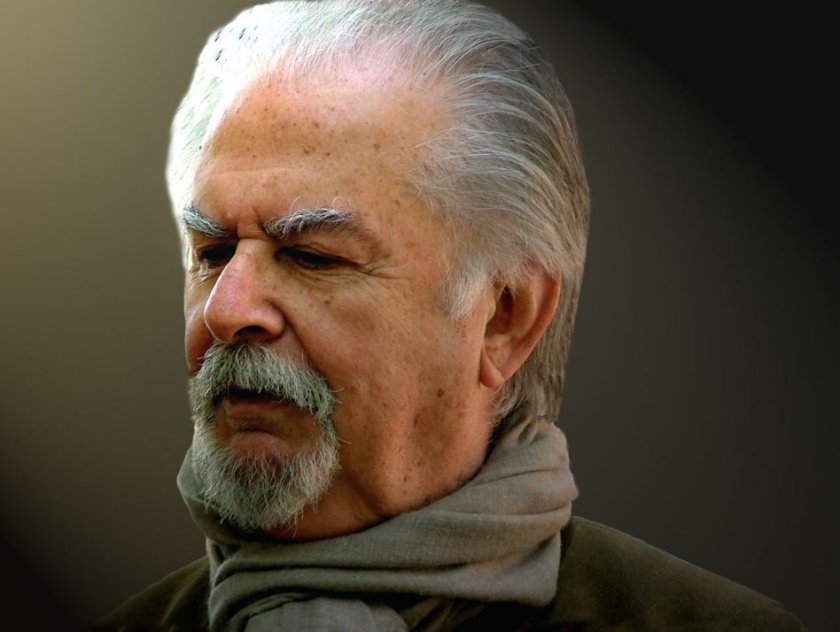
Every bit we are in the heart of holiday celebrations I thought I would lighten my blog with an artist whose works always bring a smile to my confront. He is very pop, extremely talented and has a style of his own which is instantly recognisable. Although 1 would not compare his works with those of Raphael or Titian, they are truly a joy to behold. My featured artist today is the Colombian, Fernando Botero. I will intersperse his life story with some of his paintings and I accept concentrated on his version of some of the world'southward greatest works by the Masters of the by.

Fernando Botero Angulo was built-in on April nineteenthursday 1932. His birthplace was Medellin, an industrial town situated loftier up in the Colombian Andes. He was the 2d of three sons of David Botero and Flora Angulo. His mother was a seamstress and his father was a salesman and due to the mountainous terrain of his habitation region, had to travel around on horseback. In 1936, when Fernando was just four years of historic period, his father died of a heart attack and one of his uncles became the main man in his early life. In 1938 he starts his instruction at a local primary school. He proved to exist a very able pupil, so much and so that at the end of his primary school education, he gained a scholarship to the Jesuit high school in Medellin.
Whereas young boys in Britain dream of being a soccer star, Fernando'south dream was to get a balderdash fighter and at the age of twelve, also as his normal schooling, his uncle had him enrolled at a bull fighting school. During his fourth dimension at school he began to show a love of drawing and painting with watercolours and his first watercolour work was 1 of a bull-fighting scene. His artwork improved steadily and in 1948 he, along with other aspiring artists of the regions, held a group exhibition of their work. The following yr he begins to draw illustrations for the Sun supplement of the Medellin newspaper, El Combiano. He finished loftier schoolhouse in 1949, aged 17, and enrolled at the Liceo de Marinilla de Antioquia in the neighbouring town of Marinilla. To attend this college he had to function fund his education and he did that by continuing with his illustrative work for local newspapers. He completed his didactics in 1950 and after a few months working as a stage-set designer he moves to Bogotá. He has been slowly building up a collection of his ain works and in 1951 he exhibited a mix of watercolours, drawings and oil paintings at the Leo Matiz Gallery, some of which were sold. Buoyed upwards by the sale of his work he takes himself off to the coast that summer and spends the fourth dimension relaxing and painting.

In 1952 he had a second exhibition of his work which included all of his previous summer's work. The exhibition was an outstanding success and all his paintings were sold and he was better off by $2000. His coffers were farther filled by 7000 pesos which he received for the Second Prize at the Ninth Salon of Colombian Artists held in Bogotá. Now with all the coin he had accrued he could realise his dream of going to Europe and studying the paintings of the European Masters. He and some of his artist friends gear up sail aboard an Italian liner leap for Barcelona where he arrived during late autumn. After a brusque 2-solar day stay in the Catalonian capital he went on to Madrid and enrolled at Madrid's university of art, the Academia de San Fernando. He was somewhat disillusioned with the teaching he received at the academy and remained at that place for simply 2 semesters. Botero spent virtually of his fourth dimension whilst in Madrid making many visits to the Prado where he saw the works of the great artists of the past such as Titian, Rubens, Goya and his all-time favourite, Velazquez. He made a number of copies of the originals which he managed to sell. In 1986 he completed a cocky portrait dressed as Velazquez.

Over the side by side few years Botero travelled effectually Europe. In 1953 he lived in Paris, with his friend the film director, Ricardo Irragarri in the Identify des Voges. Although Botero falls into the category of a Modernistic artist he favoured the Louvre over the establishments exhibiting mod works. Information technology was at the Louvre that he became interested in early Italian art. At the cease of the summer of 1953, Botero and Irragarri moved to Florence. For Botero it was dear at first sight and he decided to make Florence his home, set up his studio in the Via Panicale and also enrolled at the Academia San Marco where he learnt all virtually fresco painting and went to fine art history lectures centring around 15th century Italian art, the time oft referred to as the Quattrocentro. In Florence he was and then able to written report the works of the Renaissance masters. He also extensively travelled effectually Italy on his motorcycle visiting Arezzo, Padua, Siena and Venice and at every stopping-off place he would visit the local museums and seek out the works of the great Italian painters such as Piero della Francesca, Giotto, Uccello, Carpaccio, Giorgione and Titian.

In all, Botero remained in Europe for four years before returning to Bogotá in March 1955. He did not return empty-handed for during his four year European sojourn he had been continually painting and on his arrival back in Republic of colombia he was excited to exhibit these works at the National Library in Bogotá. His last exhibition of work in 1952 had been a sell-out then he had high hopes for this new set of paintings. Alas, it was a total anti-climax. The people who came to the exhibition did not like what they saw. They wanted to meet more mod works of art and Botero was offer a more classical and academic style of paintings. None of his works sold. Botero was at present in drastic need for money and, for a ten week period, he fifty-fifty took on a task as a motorcar tyre salesman to earn enough to feed and house himself. He and so reverted to earning money past his illustrative work for magazines.

A turning bespeak in his life came in December 1956 when he married Gloria Zea, the girl of the liberal political leader Germán Zea Hernández. The couple moved to Mexico where Botero believed his mod art would achieve the same fame that the Mexican painters Diego Rivera and Frida Kahlo had plant. The couple went on to take iii children, Fernando born in 1957, Lina born in 1958, and Juan Carlos born in 1960. It was also in this year that Fernando Botero first produced a work which incorporated his ain inimitable style.

It was during his short stay in United mexican states that Botero produced a work which was entitled However Life with Mandolin. This was his beginning work in which we saw what was termed his "puffed-up" mode. In this painting Botero had experimented with scale and volume. In the work nosotros tin see how he has puffed-up the size of the instrument and altered the true size of the hole in the musical instrument, out of which resonates the sound. This unusual enlargement of shapes and people in his works of fine art became known as Boterismo. When asked why he always painted fat people, he denied it. Botero was a figurative painter but i could non label him as a realistic painter and although his paintings may be focused on his depictions, they could not be further from reality. Information technology is non simply the people we see in his works of art who are voluminous, all the inanimate items depicted likewise took on this over-sized quality. His deformation of the people and items he depicted in his piece of work was a transformation into his own imitable style. One cannot compare his work to those of his favourite painters Velazquez and Raphael as that would exist like comparing apples with oranges. However in that location is something about his piece of work which I find totally beguiling. I am captivated by his over-large people. It is a type of art which makes you smile and surely that cannot be bad.

Botero and his wife left Mexico and returned to Bogotá. In 1957 he had his first solo exhibition in the United States, in Washington DC. And it was whilst he was at the exhibition he was able to study the works of the leading American gimmicky artists such as Jackson Pollock and Willem de Kooning. He returned to Bogotá via United mexican states, fully invigorated by what he had seen in America. He returned to his homeland and was an artistic hero. In 1958 he was appointed professor of painting at the Bogotá Academy of Art. He had his work exhibited at the Gres Gallery in Washington, owned by Tania Gres whom he had met the year before. A 2d solo exhibition of his paintings at her gallery was staged in 1960. More and more of his work found favour amid American collectors and he spent more time away from abode in the United States. He realised that to progress as an creative person he had to move to America. This may have put a strain on his relationship with his wife equally in 1960 his marriage to Gloria was dissolved.

Botero moved to America and set up his studio in an apartment in Greenwich Hamlet during the winter of 1960. The sales of his work slowed downward and he was living a frugal and somewhat alone existence. Botero was a fighter and his decision carried him through these inauspicious and difficult times when money was tight, rejection of his piece of work was the norm and his paintings frequently received unfavourable reviews from the art critics and his New York colleagues who belonged to the Abstract Expressionist schoolhouse. However in 1961 he was given the Guggenheim International award for his painting entitled The Battle of the Arch-Devil and his big break came in 1963. The Metropolitan Museum in New York had on display Michelangelo's Mona Lisa and to counter this allure the Metropolitan Museum of Modern Art decided to purchase Botero's 1959 piece of work entitled Mona Lisa, Aged 12 and had the large foursquare sail (211cms x 195cms) hung in the anteroom of their museum. It acquired a sensation and overnight Botero became famous in the city. Ane affair led to another and soon Botero was the toast of the city and was introduced to the contemporary artists whose work he had e'er admired such as Pollock, Rothko, Fritz Kline and de Kooning. With fame came fortune and he moved from his minor studio to a much larger one in New York's Lower Due east Side.
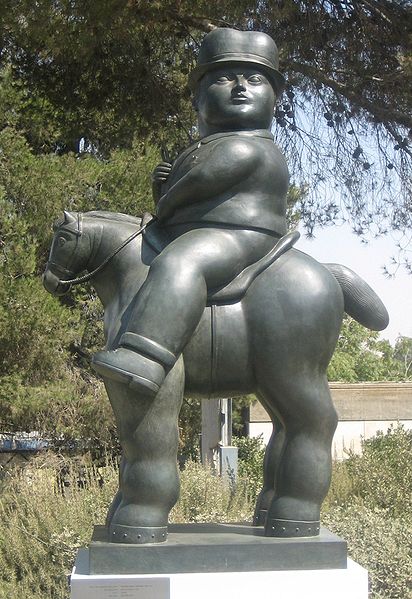
In 1964, Fernando Botero married for the second time. His wife was Cecilia Zambrano. In 1971 he rented a apartment in Paris and commuted between the French upper-case letter and New York. The couple had a son, Pedro in 1974 simply a year after their son's birth, the couple separated. Sadly Pedro was killed in a car accident in 1979 in which Botero himself was severely injured. Equally the years passed, sculpture gained bully importance in Botero's life. In 1983 Botero moved to Pietrasanta, a Tuscan boondocks in Italian republic which was famous for its foundries and numerous marble quarries. He was then taken up by his sculpture work that he spent several months each twelvemonth in Italy. However he never abased his painting and it was during this catamenia that he turned out many works depicting bull-fighting which gained many favourable reviews and were much in demand for exhibitions.

His fame continued to grow and in 2005 he completed his virtually controversial series of over fourscore paintings and drawings which depicted stylized renditions of prisoner abuse by American guards at the Abu Ghraib prison house in Iraq. Although these works had been exhibited in Europe, information technology was not until 2007 that they had been shown in the The states, with the exception of a small-scale private bear witness at New York's Marlborough Gallery. On January 29th 2007, the exhibition Botero: Abu Ghraib opened at the Doe Library of the University of California at Berkeley. Forty-3 works from the serial were on show, each depicted the torture in Abu Ghraib. The exhibition was sponsored by the Centre for Latin American Studies. These were powerful and disturbing depictions and the prisoners' large bodies dominated the big canvases. People who looked at the works often spoke of how they too felt the pain and empathized with the people who suffered the dreadful weather condition of their captivity.

Botero has never established a settled lifestyle and seems to exist always on the move travelling between New York, his summer house in Republic of colombia, and his apartments in New York, and Paris every bit well equally his business firm in Pietrasanta. Fernando Botero, who will be 82 in April 2014, is currently married to his third wife, Sophia Vari, a highly respected and talented Greek sculptor.
If you would like to read more than almost Fernando Botero and his art, I tin can recommend you buy the minor, well illustrated book simply entitled Botero. The author is Mariana Hanstein.

sandovalyestioured.blogspot.com
Source: https://mydailyartdisplay.uk/2013/12/28/fernando-botero/
0 Response to "Colombian Artist Fernando Botero Funny Horse Pictures"
Post a Comment