Until 1955 the Music Business Was Segregated Into Pop Rhythm and Blues and Country and Western
| Rock and coil | |
|---|---|
| Stylistic origins |
|
| Cultural origins | Tardily 1940s – early 1950s, The states |
| Derivative forms |
|
| Regional scenes | |
| |
| Other topics | |
| |
Stone and roll (ofttimes written as stone & scroll, rock 'n' roll, or rock 'n roll) is a genre of pop music that evolved in the U.s.a. during the late 1940s and early on 1950s.[1] [2] [ page needed ] Information technology originated from African-American music such equally jazz, rhythm and dejection, boogie woogie, gospel, also as country music.[three] While rock and roll's formative elements can be heard in blues records from the 1920s[iv] and in country records of the 1930s,[v] the genre did not learn its name until 1954.[6] [2]
Co-ordinate to journalist Greg Kot, "rock and whorl" refers to a way of popular music originating in the United states in the 1950s. By the mid-1960s, stone and roll had developed into "the more encompassing international style known every bit rock music, though the latter also continued to exist known in many circles equally rock and gyre."[7] For the purpose of differentiation, this article deals with the first definition.
In the earliest rock and curlicue styles, either the piano or saxophone was typically the lead instrument. These instruments were generally replaced or supplemented past guitar in the centre to belatedly 1950s.[8] The beat is essentially a dance rhythm[9] with an accentuated backbeat, near ever provided by a snare pulsate.[10] Classic rock and roll is unremarkably played with one or two electric guitars (i lead, one rhythm) and a double bass (string bass). Later on the mid-1950s, electric bass guitars ("Fender bass") and pulsate kits became popular in classic rock.[8]
Stone and coil had a polarizing influence on lifestyles, fashion, attitudes, and language. Information technology is ofttimes depicted in movies, fan magazines, and on television. Rock and roll is believed by some to have had a positive influence on the ceremonious rights movement, because both Blackness American and White American teenagers enjoyed the music.[11]
Terminology [edit]

The term "rock and roll" is defined by Greg Kot in Encyclopædia Britannica every bit the music that originated in the mid-1950s and later adult "into the more encompassing international mode known equally rock music".[vii] The term is sometimes too used as synonymous with "rock music" and is defined as such in some dictionaries.[12] [13]
The phrase "rocking and rolling" originally described the movement of a ship on the bounding main,[xiv] but past the early 20th century was used both to describe the spiritual fervor of black church rituals[15] and as a sexual analogy. A retired Welsh seaman named William Fender can exist heard singing the phrase "rock and whorl" when describing a sexual encounter in his functioning of the traditional vocal "The Baffled Knight" to the folklorist James Madison Carpenter in the early 1930s, which he would have learned at sea in the 1800s; the recording can be heard on the Vaughan Williams Memorial Library website.[16]
Diverse gospel, blues and swing recordings used the phrase before it became widely popular; it was used in 1940s recordings and reviews of what became known as "rhythm and dejection" music aimed at a black audience.[15]
In 1934, the song "Stone and Curlicue" by the Boswell Sisters appeared in the film Transatlantic Merry-Go-Circular. In 1942, before the concept of rock and roll had been defined, Billboard magazine columnist Maurie Orodenker started to use the term to describe upbeat recordings such equally "Stone Me" past Sister Rosetta Tharpe; her style on that recording was described as "rock-and-roll spiritual singing".[17] [18] By 1943, the "Stone and Whorl Inn" in South Merchantville, New Jersey, was established as a music venue.[19] In 1951, Cleveland, Ohio, disc jockey Alan Freed began playing this music way, and referring to it as "stone and curlicue"[20] on his mainstream radio program, which popularized the phrase.[21]
Several sources propose that Freed found the term, used as a synonym for sexual intercourse, on the record "Sixty Minute Man" by Billy Ward and his Dominoes.[22] [23] The lyrics include the line, "I stone 'em, coil 'em all night long".[24] Freed did not acknowledge the suggestion about that source in interviews, and explained the term as follows: "Rock 'n roll is really swing with a modern name. Information technology began on the levees and plantations, took in folk songs, and features blues and rhythm".[25]
In discussing Alan Freed'due south contribution to the genre, 2 pregnant sources emphasized the importance of African-American rhythm and blues. Greg Harris, then the Executive Managing director of the Rock northward Roll Hall of Fame, offered this comment to CNN: "Freed's role in breaking downward racial barriers in U.S. pop culture in the 1950s, by leading white and black kids to listen to the same music, put the radio personality 'at the vanguard' and fabricated him 'a actually of import figure'".[26] Later on Freed was honored with a star on the Hollywood Walk of Fame, the organization'south Web site offered this comment: "He became internationally known for promoting African-American rhythm and blues music on the radio in the United States and Europe under the name of stone and roll".[27]
Not often acknowledged in the history of stone and scroll, Todd Storz, the owner of radio station KOWH in Omaha, Nebraska, was the first to adopt the Elevation 40 format (in 1953), playing just the about popular records in rotation. His station, and the numerous others which adopted the concept, helped to promote the genre: by the mid 50s, the playlist included artists such as "Presley, Lewis, Haley, Berry and Domino".[28] [29]
Early rock and curlicue [edit]
Origins [edit]
The origins of rock and ringlet have been fiercely debated by commentators and historians of music.[30] In that location is full general agreement that it arose in the Southern U.s. – a region that would produce virtually of the major early on rock and roll acts – through the coming together of various influences that embodied a merging of the African musical tradition with European instrumentation.[31] The migration of many former slaves and their descendants to major urban centers such as St. Louis, Memphis, New York City, Detroit, Chicago, Cleveland, and Buffalo meant that black and white residents were living in close proximity in larger numbers than ever before, and equally a issue heard each other's music and even began to emulate each other'due south fashions.[32] [33] Radio stations that made white and black forms of music bachelor to both groups, the development and spread of the gramophone tape, and African-American musical styles such as jazz and swing which were taken up by white musicians, aided this process of "cultural collision".[34]
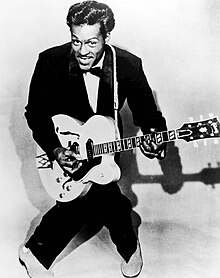
The immediate roots of rock and roll lay in the rhythm and dejection, so called "race music",[35] in combination with either boogie-woogie and shouting gospel[36] or with country music of the 1940s and 1950s. Specially significant influences were jazz, blues, gospel, state, and folk.[30] Commentators differ in their views of which of these forms were most of import and the caste to which the new music was a re-branding of African-American rhythm and dejection for a white market, or a new hybrid of black and white forms.[37] [38] [39]
In the 1930s, jazz, and particularly swing, both in urban-based trip the light fantastic toe bands and blues-influenced country swing (Jimmie Rodgers, Moon Mullican and other similar singers), were among the get-go music to present African-American sounds for a predominantly white audition.[38] [40] One particularly noteworthy example of a jazz song with recognizably rock and curlicue elements is Big Joe Turner with pianist Pete Johnson's 1939 single Roll 'Em Pete, which is regarded as an important precursor of rock and coil.[41] [42] [43] The 1940s saw the increased utilize of blaring horns (including saxophones), shouted lyrics and boogie-woogie beats in jazz-based music. During and immediately subsequently World War 2, with shortages of fuel and limitations on audiences and available personnel, large jazz bands were less economical and tended to be replaced past smaller combos, using guitars, bass and drums.[thirty] [44] In the aforementioned menstruum, specially on the West Declension and in the Midwest, the evolution of leap blues, with its guitar riffs, prominent beats and shouted lyrics, prefigured many later developments.[thirty] In the documentary film Hail! Hail! Stone 'n' Roll, Keith Richards proposes that Chuck Berry adult his brand of rock and scroll past transposing the familiar two-notation lead line of jump blues piano straight to the electrical guitar, creating what is instantly recognizable as stone guitar. This proposal by Richards neglects the black guitarists who did the same thing before Berry, such as Goree Carter,[45] Gatemouth Brown,[46] and the originator of the mode, T-Bone Walker.[47] Land boogie and Chicago electric blues supplied many of the elements that would exist seen as characteristic of stone and ringlet.[30] Inspired by electric blues, Chuck Berry introduced an aggressive guitar sound to rock and ringlet, and established the electric guitar as its centerpiece,[48] adapting his rock ring instrumentation from the basic blues band instrumentation of a pb guitar, second chord musical instrument, bass and drums.[49] In 2017, Robert Christgau declared that "Chuck Berry did in fact invent rock 'n' curl", explaining that this artist "came the closest of whatever single effigy to being the one who put all the essential pieces together".[l]

Pecker Haley and his Comets performing in the 1954 Universal International film Round Upwards of Rhythm
Stone and roll arrived at a fourth dimension of considerable technological change, soon afterwards the development of the electrical guitar, amplifier and microphone, and the 45 rpm tape.[thirty] There were also changes in the record industry, with the rise of contained labels similar Atlantic, Dominicus and Chess servicing niche audiences and a like rise of radio stations that played their music.[30] Information technology was the realization that relatively affluent white teenagers were listening to this music that led to the development of what was to be divers as rock and whorl as a singled-out genre.[30] Because the development of stone and roll was an evolutionary process, no single record can be identified as unambiguously "the first" stone and scroll record.[2] Contenders for the title of "commencement rock and roll record" include Sister Rosetta Tharpe's "Strange Things Happening Every 24-hour interval" (1944),[51] "That's All Correct" by Arthur Crudup (1946), "Movement It On Over" by Hank Williams (1947),[52] "The Fatty Homo" by Fats Domino (1949),[2] Goree Carter'south "Rock Awhile" (1949),[53] Jimmy Preston'due south "Rock the Joint" (1949) (later on covered by Pecker Haley & His Comets in 1952),[54] "Rocket 88" by Jackie Brenston and his Delta Cats (Ike Turner and his band The Kings of Rhythm), recorded by Sam Phillips for Lord's day Records in March 1951.[55] In terms of its broad cultural affect across lodge in the U.s. and elsewhere, Bill Haley'south "Rock Around the Clock",[56] recorded in April 1954 merely non a commercial success until the following twelvemonth, is generally recognized as an important milestone, only information technology was preceded past many recordings from earlier decades in which elements of rock and roll can be conspicuously discerned.[2] [57] [58]
Other artists with early stone and roll hits included Chuck Berry, Bo Diddley, Petty Richard, Jerry Lee Lewis, and Gene Vincent.[55] Chuck Drupe's 1955 classic "Maybellene" in particular features a distorted electric guitar solo with warm overtones created by his small valve amplifier.[59] Withal, the apply of distortion was predated by electrical blues guitarists such equally Joe Hill Louis,[60] Guitar Slim,[61] Willie Johnson of Howlin' Wolf's band,[62] and Pat Hare; the latter two also made use of distorted power chords in the early 1950s.[63] As well in 1955, Bo Diddley introduced the "Bo Diddley crush" and a unique electric guitar style,[64] influenced by African and Afro-Cuban music and in turn influencing many later artists.[65] [66] [67]
Rhythm and blues [edit]
Stone and whorl was strongly influenced past R&B, according to many sources, including an article in the Wall Street Journal in 1985 titled, "Rock! It'southward Still Rhythm and Blues". In fact, the writer stated that the "two terms were used interchangeably", until about 1957. The other sources quoted in the article said that stone and roll combined R&B with pop and state music.[68]
Fats Domino was one of the biggest stars of stone and roll in the early 1950s and he was non convinced that this was a new genre. In 1957, he said: "What they call stone 'n' scroll now is rhythm and blues. I've been playing information technology for 15 years in New Orleans".[69] According to Rolling Stone, "this is a valid statement ... all Fifties rockers, black and white, state born and urban center-bred, were fundamentally influenced by R&B, the black popular music of the late Forties and early Fifties".[70] Farther, Little Richard congenital his ground-breaking audio of the same era with an uptempo blend of boogie-woogie, New Orleans rhythm and dejection, and the soul and fervor of gospel music vocalisation.[36]
Rockabilly [edit]

"Rockabilly" usually (merely not exclusively) refers to the type of rock and roll music which was played and recorded in the mid-1950s primarily by white singers such as Elvis Presley, Carl Perkins, Johnny Cash, and Jerry Lee Lewis, who drew mainly on the state roots of the music.[71] [72] Presley was greatly influenced by and incorporated his mode of music with that of some of the greatest African American musicians like BB King, Arthur Crudup and Fats Domino. His mode of music combined with black influences created controversy during a turbulent time in history.[72] Many other pop stone and gyre singers of the time, such equally Fats Domino and Little Richard,[73] came out of the blackness rhythm and blues tradition, making the music attractive to white audiences, and are non normally classed equally "rockabilly".
Presley popularized stone and whorl on a wider scale than any other single performer and by 1956, he had emerged as the singing awareness of the nation.[74]
Bill Flagg who is a Connecticut resident, began referring to his mix of hillbilly and rock 'n' roll music as rockabilly around 1953.[75]
In July 1954, Presley recorded the regional striking "That'due south All Right" at Sam Phillips' Dominicus Studio in Memphis.[76] Three months earlier, on April 12, 1954, Neb Haley & His Comets recorded "Rock Around the Clock". Although only a minor hit when first released, when used in the opening sequence of the movie Blackboard Jungle a year subsequently, it fix the stone and whorl nail in motion.[56] The song became 1 of the biggest hits in history, and frenzied teens flocked to see Haley and the Comets perform information technology, causing riots in some cities. "Rock Effectually the Clock" was a quantum for both the grouping and for all of rock and curl music. If everything that came before laid the groundwork, "Rock Around the Clock" introduced the music to a global audience.[77]
In 1956, the arrival of rockabilly was underlined by the success of songs like "Folsom Prison Dejection" by Johnny Greenbacks, "Blue Suede Shoes" past Perkins, and the No. i hit "Heartbreak Hotel" by Presley.[72] For a few years it became the most commercially successful form of rock and roll. Subsequently rockabilly acts, particularly performing songwriters like Buddy Holly, would be a major influence on British Invasion acts and particularly on the vocal writing of the Beatles and through them on the nature of later rock music.[78]
Doo wop [edit]
Doo-wop was one of the most popular forms of 1950s rhythm and dejection, often compared with rock and coil, with an emphasis on multi-part vocal harmonies and meaningless bankroll lyrics (from which the genre later gained its name), which were usually supported with lite instrumentation.[79] Its origins were in African-American vocal groups of the 1930s and 40s, such as the Ink Spots and the Mills Brothers, who had enjoyed considerable commercial success with arrangements based on close harmonies.[80] They were followed by 1940s R&B vocal acts such as the Orioles, the Ravens and the Clovers, who injected a strong element of traditional gospel and, increasingly, the energy of spring blues.[eighty] By 1954, as rock and roll was starting time to emerge, a number of similar acts began to cross over from the R&B charts to mainstream success, often with added honking brass and saxophone, with the Crows, the Penguins, the El Dorados and the Turbans all scoring major hits.[80] Despite the subsequent explosion in records from doo wop acts in the later 1950s, many failed to chart or were one-hit wonders. Exceptions included the Platters, with songs including "The Great Pretender" (1955)[81] and the Coasters with humorous songs like "Yakety Yak" (1958),[82] both of which ranked among the most successful rock and roll acts of the era.[80] Towards the end of the decade there were increasing numbers of white, particularly Italian-American, singers taking upwardly doo wop, creating all-white groups like the Mystics and Dion and the Belmonts and racially integrated groups like the Del-Vikings and the Impalas.[lxxx] Doo-wop would exist a major influence on vocal surf music, soul and early on Merseybeat, including the Beatles.[80]
Comprehend versions [edit]

Many of the earliest white rock and roll hits were covers or partial re-writes of earlier black rhythm and blues or blues songs.[83] Through the belatedly 1940s and early on 1950s, R&B music had been gaining a stronger beat and a wilder style, with artists such as Fats Domino and Johnny Otis speeding up the tempos and increasing the backbeat to slap-up popularity on the juke joint circuit.[84] Before the efforts of Freed and others, black music was taboo on many white-endemic radio outlets, but artists and producers quickly recognized the potential of rock and whorl.[85] Some of Presley's early on recordings were covers of black rhythm and blues or blues songs, such every bit "That's All Right" (a countrified organization of a blues number), "Baby Let's Play House", "Lawdy Miss Clawdy", and "Hound Dog".[86] The racial lines, however, are rather more clouded by the fact that some of these R&B songs originally recorded by blackness artists had been written past white songwriters, such every bit the team of Jerry Leiber and Mike Stoller. Songwriting credits were often unreliable; many publishers, record executives, and even managers (both white and blackness) would insert their proper noun as a composer in society to collect royalty checks.
Covers were customary in the music manufacture at the time; it was made peculiarly easy past the compulsory license provision of United States copyright law (nevertheless in issue).[87] One of the first relevant successful covers was Wynonie Harris's transformation of Roy Brown's 1947 original jump blues hit "Skillful Rocking Tonight" into a more showy rocker[88] and the Louis Prima rocker "Oh Babe" in 1950, equally well as Amos Milburn's embrace of what may have been the kickoff white rock and coil record, Hardrock Gunter'south "Birmingham Bounciness" in 1949.[89] The virtually notable trend, all the same, was white pop covers of blackness R&B numbers. The more than familiar sound of these covers may have been more palatable to white audiences, there may have been an chemical element of prejudice, simply labels aimed at the white market likewise had much better distribution networks and were by and large much more assisting.[90] Famously, Pat Boone recorded sanitized versions of songs recorded by the likes of Fats Domino, Little Richard, the Flamingos and Ivory Joe Hunter. After, as those songs became popular, the original artists' recordings received radio play as well.[91]
The encompass versions were not necessarily straightforward imitations. For example, Bill Haley'south incompletely bowdlerized cover of "Milkshake, Rattle and Scroll" transformed Big Joe Turner's humorous and racy tale of adult love into an energetic teen dance number,[83] [92] while Georgia Gibbs replaced Etta James's tough, sarcastic vocal in "Curl With Me, Henry" (covered as "Dance With Me, Henry") with a perkier song more advisable for an audition unfamiliar with the vocal to which James's vocal was an reply, Hank Ballard's "Work With Me, Annie".[93] Presley'southward rock and roll version of "Hound Dog", taken mainly from a version recorded by the pop band Freddie Bell and the Bellboys, was very dissimilar from the blues shouter that Big Mama Thornton had recorded four years earlier.[94] [95] Other white artists who recorded cover versions of rhythm and blues songs included Gale Storm (Smiley Lewis' "I Hear You Knockin'"), the Diamonds (The Gladiolas' "Little Darlin'" and Frankie Lymon & the Teenagers' "Why Do Fools Autumn in Love?"), the Crew Cuts (the Chords' "Sh-Boom" and Nappy Brown's "Don't Be Angry"), the Fountain Sisters (The Jewels' "Hearts of Stone") and the Maguire Sisters (The Moonglows' "Sincerely").
Turn down [edit]
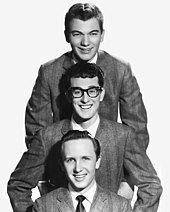
Some commentators have suggested a decline of rock and ringlet in the belatedly 1950s and early on 1960s.[96] [97] The retirement of Lilliputian Richard to get a preacher (October 1957), the departure of Presley for service in the United States Army (March 1958), the scandal surrounding Jerry Lee Lewis' spousal relationship to his thirteen-year-old cousin (May 1958), the deaths of Buddy Holly, The Big Bopper and Ritchie Valens in a plane crash (February 1959), the breaking of the Payola scandal implicating major figures, including Alan Freed, in bribery and corruption in promoting individual acts or songs (November 1959), the abort of Chuck Berry (Dec 1959), and the death of Eddie Cochran in a automobile crash (April 1960) gave a sense that the initial phase of stone and roll had come to an cease.[98]
During the late 1950s and early on 1960s, the rawer sounds of Presley, Gene Vincent, Jerry Lee Lewis and Buddy Holly were commercially superseded by a more than polished, commercial style of stone and scroll. Marketing ofttimes emphasized the physical looks of the artist rather than the music, contributing to the successful careers of Ricky Nelson, Tommy Sands, Bobby Vee and the Philadelphia trio of Bobby Rydell, Frankie Avalon, Fabian, and Del Shannon, who all became "teen idols".[99]
Some music historians have also pointed to important and innovative developments that built on stone and roll in this period, including multitrack recording, developed by Les Paul, the electronic treatment of sound by such innovators as Joe Meek, and the "Wall of Sound" productions of Phil Spector,[100] continued desegregation of the charts, the rise of surf music, garage rock and the Twist dance craze.[38] Surf rock in particular, noted for the employ of reverb-drenched guitars, became 1 of the most popular forms of American stone of the 1960s.[101]
British rock and roll [edit]

Tommy Steele, i of the commencement British rock and rollers, performing in Stockholm in 1957
In the 1950s, United kingdom was well placed to receive American stone and gyre music and civilization.[102] Information technology shared a common language, had been exposed to American civilisation through the stationing of troops in the country, and shared many social developments, including the emergence of singled-out youth sub-cultures, which in Britain included the Teddy Boys and the rockers.[103] Trad jazz became popular in the United kingdom of great britain and northern ireland, and many of its musicians were influenced by related American styles, including boogie woogie and the blues.[104] The skiffle craze, led by Lonnie Donegan, utilised non-expert versions of American folk songs and encouraged many of the subsequent generation of stone and roll, folk, R&B and shell musicians to first performing.[105] At the same fourth dimension British audiences were beginning to encounter American rock and coil, initially through films including Blackboard Jungle (1955) and Stone Around the Clock (1956).[106] Both movies featured the Pecker Haley & His Comets hit "Rock Around the Clock", which first entered the British charts in early 1955 – 4 months before it reached the Usa popular charts – topped the British charts later that yr and once more in 1956, and helped identify stone and curl with teenage malversation.[107]
The initial response of the British music manufacture was to try to produce copies of American records, recorded with session musicians and ofttimes fronted by teen idols.[102] More grassroots British rock and rollers soon began to announced, including Wee Willie Harris and Tommy Steele.[102] During this menses American Stone and Roll remained dominant; however, in 1958 Britain produced its kickoff "accurate" rock and gyre song and star, when Cliff Richard reached number two in the charts with "Move It".[108] At the aforementioned time, Tv shows such as Vi-Five Special and Oh Boy! promoted the careers of British rock and rollers like Marty Wilde and Adam Faith.[102] Cliff Richard and his backing ring, the Shadows, were the most successful abode grown stone and curl based acts of the era.[109] Other leading acts included Billy Fury, Joe Brownish, and Johnny Kidd & the Pirates, whose 1960 hitting song "Shakin' All Over" became a rock and roll standard.[102]
As interest in rock and roll was beginning to subside in America in the late 1950s and early on 1960s, it was taken upwards by groups in major British urban centers like Liverpool, Manchester, Birmingham, and London.[110] About the same time, a British dejection scene developed, initially led past purist blues followers such as Alexis Korner and Cyril Davies who were directly inspired by American musicians such as Robert Johnson, Dirty Waters and Howlin' Wolf.[111] Many groups moved towards the beat music of rock and gyre and rhythm and dejection from skiffle, like the Quarrymen who became the Beatles, producing a form of rock and roll revivalism that carried them and many other groups to national success from about 1963 and to international success from 1964, known in America as the British Invasion.[112] Groups that followed the Beatles included the crush-influenced Freddie and the Dreamers, Wayne Fontana and the Mindbenders, Herman'south Hermits and the Dave Clark Five.[113] Early British rhythm and blues groups with more than blues influences include the Animals, the Rolling Stones, and the Yardbirds.[114]
Cultural influence [edit]
Rock and curl influenced lifestyles, fashion, attitudes, and language.[115] In addition, rock and roll may accept contributed to the civil rights movement because both African-American and white American teens enjoyed the music.[xi]
Many early rock and scroll songs dealt with issues of cars, school, dating, and clothing. The lyrics of rock and roll songs described events and conflicts to which most listeners could relate through personal experience. Topics such as sex that had generally been considered taboo began to announced in stone and whorl lyrics. This new music tried to pause boundaries and limited emotions that people were actually feeling only had non discussed openly. An awakening began to take place in American youth culture.[116]
Race [edit]
In the crossover of African-American "race music" to a growing white youth audience, the popularization of rock and coil involved both black performers reaching a white audition and white musicians performing African-American music.[117] Rock and coil appeared at a time when racial tensions in the United States were entering a new stage, with the ancestry of the ceremonious rights move for desegregation, leading to the U.Due south. Supreme Court ruling that abolished the policy of "separate but equal" in 1954, merely leaving a policy which would exist extremely hard to enforce in parts of the United States.[118] The meeting of white youth audiences and black music in rock and ringlet inevitably provoked strong white racist reactions within the Us, with many whites condemning its breaking downward of barriers based on colour.[11] Many observers saw rock and curlicue equally heralding the way for desegregation, in creating a new course of music that encouraged racial cooperation and shared experience.[119] Many authors have argued that early rock and coil was instrumental in the way both white and blackness teenagers identified themselves.[120]
Teen culture [edit]
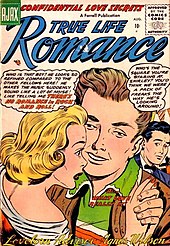
"There's No Romance in Rock and Roll" made the cover of True Life Romance in 1956
Several rock historians have claimed that rock and roll was one of the first music genres to define an historic period group.[121] Information technology gave teenagers a sense of belonging, fifty-fifty when they were alone.[121] Rock and scroll is often identified with the emergence of teen culture amongst the first baby boomer generation, who had greater relative abundance and leisure time and adopted rock and roll as part of a distinct subculture.[122] This involved not just music, absorbed via radio, record buying, jukeboxes and Boob tube programs similar American Bandstand, but likewise extended to film, clothes, hair, cars and motorcycles, and distinctive linguistic communication. The youth culture exemplified by rock and gyre was a recurring source of concern for older generations, who worried about juvenile delinquency and social rebellion, particularly because, to a large extent, stone and roll civilisation was shared by different racial and social groups.[122]
In America, that concern was conveyed even in youth cultural artifacts such as comic books. In "In that location's No Romance in Rock and Roll" from True Life Romance (1956), a defiant teen dates a rock and roll-loving male child but drops him for i who likes traditional adult music—to her parents' relief.[123] In Britain, where postwar prosperity was more than limited, rock and roll culture became attached to the pre-existing Teddy Male child movement, largely working class in origin, and eventually to the rockers.[103] "On the white side of the deeply segregated music market", rock and whorl became marketed for teenagers, as in Dion and the Belmonts' "A Teenager in Beloved" (1959).[124]
Dance styles [edit]
From its early 1950s beginnings through the early on 1960s, rock and gyre spawned new dance crazes[125] including the twist. Teenagers establish the syncopated backbeat rhythm especially suited to reviving Big Band-era jitterbug dancing. Sock hops, school and church gym dances, and home basement dance parties became the rage, and American teens watched Dick Clark's American Bandstand to keep upwards on the latest dance and fashion styles.[126] From the mid-1960s on, as "rock and roll" was rebranded every bit "rock," afterwards trip the light fantastic genres followed, leading to funk, disco, firm, techno, and hip hop.[127]
References [edit]
- ^ Farley, Christopher John (July 6, 2004). "Elvis Rocks Just He's Non the First". Time. Archived from the original on August 17, 2013. Retrieved July three, 2009.
- ^ a b c d e Jim Dawson and Steve Propes, What Was The First Rock'northward'Ringlet Record, 1992, ISBN 0-571-12939-0
- ^ Larry Birnbaum, Before Elvis: The Prehistory of Rock 'n' Roll, Scarecrow Press, 2013, p.7-x.
- ^ Davis, Francis. The History of the Blues (New York: Hyperion, 1995), ISBN 0-7868-8124-0.
- ^ Peterson, Richard A. Creating State Music: Fabricating Authenticity (1999), p. 9, ISBN 0-226-66285-3.
- ^ "The Roots of Rock 'due north' Coil 1946–1954". 2004. Universal Music Enterprises.
- ^ a b Kot, Greg, "Rock and roll" Archived April 17, 2020, at the Wayback Automobile, in the Encyclopædia Britannica, published online 17 June 2008 and also in print and in the Encyclopædia Britannica Ultimate Reference DVD; Chicago : Encyclopædia Britannica, 2010
- ^ a b S. Evans, "The development of the Dejection" in A. F. Moore, ed., The Cambridge companion to blues and gospel music (Cambridge: Cambridge Academy Press, 2002), pp. xl–42.
- ^ Busnar, Gene, It'southward Rock 'northward' Roll: A musical history of the fabulous fifties, Julian Messner, New York, 1979, p. 45
- ^ P. Hurry, Yard. Phillips, and Thou. Richards, Heinemann advanced music (Heinemann, 2001), pp. 153–4.
- ^ a b c G. C. Altschuler, All shook up: how stone 'n' roll changed America (Oxford: Oxford University Printing The states, 2003), p. 35.
- ^ "Rock music". The American Heritage Dictionary. Bartleby.com. Archived from the original on May 24, 2009. Retrieved December xv, 2008.
- ^ "Rock and gyre". Merriam-Webster's Online Dictionary. Merriam-Webster Online. Archived from the original on April 27, 2020. Retrieved December 15, 2008.
- ^ "The United Service Magazine". October 22, 2017. Archived from the original on March x, 2021. Retrieved November 19, 2020 – via Google Books.
- ^ a b "Morgan Wright'south HoyHoy.com: The Dawn of Rock 'north Curlicue". Hoyhoy.com. May 2, 1954. Archived from the original on June 24, 2011. Retrieved April 14, 2012.
- ^ "Baffled Knight, The (VWML Song Alphabetize SN17648)". The Vaughan Williams Memorial Library. Archived from the original on March 10, 2021. Retrieved Feb 3, 2021.
- ^ "Record Reviews". Billboard. May thirty, 1942. Archived from the original on June 1, 2021. Retrieved February 22, 2021.
- ^ Billboard, May 30, 1942 Archived March 10, 2021, at the Wayback Auto, page 25. Other examples are in describing Vaughn Monroe's "Coming Out Party" in the issue of June 27, 1942, page 76 Archived April xxx, 2016, at the Wayback Auto; Count Basie's "Information technology'south Sand, Man", in the event of October 3, 1942, folio 63 Archived June 10, 2016, at the Wayback Machine; and Deryck Sampson'south "Kansas Urban center Boogie-Woogie" in the consequence of October nine, 1943, page 67 Archived June 29, 2016, at the Wayback Machine.
- ^ Billboard, June 12, 1943 Archived May eleven, 2020, at the Wayback Motorcar, page 19
- ^ "Alan Freed". Britannica. March four, 2018. Archived from the original on February 5, 2020. Retrieved February three, 2021.
Alan Freed did not money the phrase he popularized it and redefined it. Once slang for sex, it came to hateful a new form of music. This music had been around for several years, but ...
- ^ Bordowitz, Hank (2004). Turning Points in Stone and Roll . New York: Citadel Press. p. 63. ISBN978-0-8065-2631-vii.
- ^ "Alan Freed". History of Rock. January 4, 2011. Archived from the original on January viii, 2021. Retrieved January 28, 2021.
- ^ "Ch. iii "Rockin' Effectually The Clock'". Michigan Rock and Ringlet Legends. June 22, 2020. Archived from the original on January 25, 2021. Retrieved January 28, 2021.
By the center of the 20th century, the phrase 'rocking and rolling' was slang for sex in the blackness customs but Freed liked the audio of it and felt the words could be used differently.
- ^ Ennis, Philip (May nine, 2012). The History of American Pop. Greenhaven. p. eighteen. ISBN978-1420506723. Archived from the original on March 10, 2021. Retrieved February 2, 2021.
- ^ "Alan Freed Dies". Ultimate Classic Rock. January 15, 2015. Archived from the original on February i, 2021. Retrieved January 28, 2021.
- ^ "Rock and Roll Hall of Fame ousts DJ Alan Freed'southward ashes, adds Beyonce's leotards". CNN. August 4, 2014. Archived from the original on February one, 2021. Retrieved January 27, 2021.
- ^ "Alan Freed". Walk of Fame. May 27, 1991. Archived from the original on February 2, 2021. Retrieved January 27, 2021.
- ^ "From Hitting Parade to Elevation 40". The Washington Postal service. June 28, 1992. Archived from the original on June ane, 2021. Retrieved April 4, 2021.
in the mid- to late '50s with upstarts named Presley, Lewis, Haley, Berry and Domino
- ^ Hall, Michael K (May 9, 2014). The Emergence of Rock and Whorl: Music and the Rise of American Youth Civilization, Timeline. Routledge. ISBN978-0415833134. Archived from the original on June i, 2021. Retrieved May 4, 2021.
- ^ a b c d e f one thousand h Bogdanov, Woodstra & Erlewine 2002, p. 1303
- ^ M. T. Bertrand, Race, Rock, and Elvis: Music in American Life (University of Illinois Printing, 2000), pp. 21–22.
- ^ R. Aquila, That old-time rock & roll: a chronicle of an era, 1954–1963 (Chicago: University of Illinois Press, 2000), pp. 4–6.
- ^ J. M. Salem, The belatedly, great Johnny Ace and the transition from R & B to rock 'northward' ringlet Music in American life (University of Illinois Printing, 2001), p. 4.
- ^ M. T. Bertrand, Race, stone, and Elvis Music in American life (Academy of Illinois Press, 2000), p. 99.
- ^ Gilliland 1969, evidence iii, testify 55.
- ^ a b Trott, Pecker (May 9, 2020). "Rock 'n' scroll pioneer Niggling Richard dies at age 87". Reuters. Archived from the original on Jan 24, 2021. Retrieved March 18, 2021.
- ^ A. Bennett, Rock and popular music: politics, policies, institutions (Routledge, 1993), pp. 236–238.
- ^ a b c Thousand. Keightley, "Reconsidering rock", in Southward. Frith, W. Straw and J. Street, eds, The Cambridge companion to popular and rock (Cambridge: Cambridge University Press, 2001), p. 116.
- ^ N. Kelley, R&B, rhythm and business organisation: the political economy of Blackness music (Akashic Books, 2005), p. 134.
- ^ East. Wald, How the Beatles Destroyed Rock North Roll: An Alternative History of American Popular Music (Oxford: Oxford University Printing, 2009), pp. 111–125.
- ^ Nick Tosches, Unsung Heroes of Rock 'n' Roll, Secker & Warburg, 1991, ISBN 0-436-53203-4
- ^ Peter J. Silvester, A Left Mitt Like God: a history of boogie-woogie piano (1989), ISBN 0-306-80359-iii.
- ^ M. Campbell, ed., Popular Music in America: And the Beat Goes on (Cengage Learning, third edn, 2008), p. 99. ISBN 0-495-50530-vii
- ^ P. D. Lopes, The ascent of a jazz art world (Cambridge: Cambridge University Press, 2002), p. 132
- ^ Robert Palmer, "Church of the Sonic Guitar", pp. 13–38 in Anthony DeCurtis, Nowadays Tense, Knuckles University Press, 1992, p. 19. ISBN 0-8223-1265-four.
- ^ Encyclopedia of Louisiana Musicians: Jazz, Blues, Cajun, Creole, Zydeco, Swamp Pop, and Gospel. Baton Rouge: Louisiana State University Press. p. 57. ISBN 9780807169322.
- ^ Dance, Helen Oakley, "Walker, Aaron Thibeaux (T-Bone)", The Handbook of Texas Online. Denton: Texas Country Historical Association.
- ^ Michael Campbell & James Brody, Rock and Scroll: An Introduction, pp. 110–111 Archived Baronial 19, 2020, at the Wayback Machine
- ^ Michael Campbell & James Brody, Rock and Roll: An Introduction, Archived March 11, 2021, at the Wayback Machine, pp. eighty–81.
- ^ "Yeah, Chuck Berry Invented Rock 'due north' Roll – and Singer-Songwriters. Oh, Teenagers Too". Foodservice and Hospitality. March 22, 2017. Archived from the original on February 27, 2021. Retrieved August two, 2020 – via Billboard.
Of grade similar musics would have sprung upwardly without him. Elvis was Elvis before he'd ever heard of Chuck Berry. Charles' proto-soul vocals and Brown's everything-is-a-drum were innovations as profound equally Drupe's. Bo Diddley was a more accomplished guitarist.
- ^ Williams, R. (March xviii, 2015). "Sister Rosetta Tharpe: the godmother of rock 'northward' curlicue". Archived from the original on July 8, 2017. Retrieved Dec 16, 2016.
- ^ Beaty, James. "Ramblin' Circular: Hank Williams: Kick open that rock 'n' gyre door". McAlester News-Uppercase. Archived from the original on March ten, 2021. Retrieved Nov v, 2020.
- ^ Robert Palmer, "Church of the Sonic Guitar", pp. xiii–38 in Anthony DeCurtis, Present Tense, Duke University Press, 1992, p. 19. ISBN 0-8223-1265-four.
- ^ Jimmy Preston at AllMusic
- ^ a b M. Campbell, ed., Popular Music in America: and the Beat Goes on (Boston, Massachusetts: Cengage Learning, third ed., 2008), ISBN 0-495-50530-7, pp. 157–8.
- ^ a b Gilliland 1969, show 5, evidence 55.
- ^ Robert Palmer, "Stone Begins", in Rolling Stone Illustrated History of Stone and Curl, 1976/1980, ISBN 0-330-26568-seven (Great britain edition), pp. 3–14.
- ^ Unterberger, Richie. Birth of Rock & Curlicue at AllMusic. Retrieved March 24, 2012.
- ^ Collis, John (2002). Chuck Berry: The Biography. Aurum. p. 38. ISBN9781854108739. Archived from the original on May 26, 2016. Retrieved Oct 17, 2015.
- ^ DeCurtis, Anthony (1992). Nowadays Tense: Rock & Roll and Culture (fourth print ed.). Durham, North Carolina: Duke Academy Press. ISBN0822312654. Archived from the original on June 17, 2016. Retrieved October 17, 2015.
His offset venture, the Phillips label, issued only one known release, and information technology was one of the loudest, about overdriven, and distorted guitar stomps always recorded, "Boogie in the Park" past Memphis 1-human-band Joe Hill Louis, who cranked his guitar while sitting and banging at a rudimentary drum kit.
- ^ Aswell, Tom (2010). Louisiana Rocks! The True Genesis of Stone & Scroll. Gretna, Louisiana: Pelican Publishing Company. pp. 61–5. ISBN978-1589806771. Archived from the original on November 22, 2016. Retrieved October 17, 2015. .
- ^ Dave, Rubin (2007). Inside the Blues, 1942 to 1982. Hal Leonard. p. 61. ISBN9781423416661. Archived from the original on April 24, 2016. Retrieved October 17, 2015.
- ^ Robert Palmer, "Church of the Sonic Guitar", pp. xiii–38 in Anthony DeCurtis, Nowadays Tense, Duke University Printing, 1992, pp. 24–27. ISBN 0-8223-1265-4.
- ^ P. Buckley, The rough guide to stone (Rough Guides, tertiary ed., 2003), p. 21.
- ^ "Bo Diddley". The Rock and Roll Hall of Fame and Museum. Archived from the original on February 12, 2011. Retrieved October 27, 2008.
- ^ "Bo Diddley". Rolling Rock. 2001. Archived from the original on August 22, 2012. Retrieved April 26, 2012.
- ^ Brown, Jonathan (June 3, 2008). "Bo Diddley, guitarist who inspired the Beatles and the Stones, dies anile 79". The Contained. Archived from the original on March 22, 2020. Retrieved April 26, 2012.
- ^ Redd, Lawrence N. (March 1, 1985). "Stone! It'southward Yet Rhythm and Blues". The Blackness Perspective in Music. thirteen (1): 31–47. doi:10.2307/1214792. JSTOR 1214792. Archived from the original on May 25, 2019. Retrieved March 15, 2021.
- ^ Leight, Elias (October 26, 2017). "Paul McCartney Remembers 'Truly Magnificent' Fats Domino". Rolling Stone.l. Archived from the original on Nov 25, 2020. Retrieved March 15, 2021.
- ^ Palmer, Robert (April nineteen, 1990). "The 50s: A Decade of Music That Changed the World". Rolling Stone. Archived from the original on Feb 22, 2021. Retrieved March 15, 2021.
- ^ Gilliland 1969, shows 7–8.
- ^ a b c "Stone and Ringlet Pilgrims: Reflections on Ritual, Religiosity, and Race". Rockabilly at AllMusic. Retrieved August half dozen, 2009.
- ^ Gilliland 1969, prove 6.
- ^ Sagolla, Lisa Jo (2011). Rock 'Northward' Roll Dances of the 1950s. The American Dance Floor. Santa Barbara, California: Greenwood. p. 17. ISBN978-0-313-36556-0.
- ^ "Granville'southward Bill Flagg pioneered rockabilly". masslive.com. Archived from the original on June 1, 2021. Retrieved April 28, 2017.
- ^ Elvis at AllMusic. Retrieved Baronial 6, 2009.
- ^ Nib Haley at AllMusic. Retrieved Baronial six, 2009.
- ^ P. Humphries, The Complete Guide to the Music of The Beatles, Volume 2 (Music Sales Group, 1998), p. 29.
- ^ F. West. Hoffmann and H. Ferstler, Encyclopedia of recorded sound, Volume 1 (CRC Press, 2nd ed., 2004), pp. 327–28.
- ^ a b c d e f Bogdanov, Woodstra & Erlewine 2002, pp. 1306–7
- ^ Gilliland 1969, show 5, track 3.
- ^ Gilliland 1969, prove xiii.
- ^ a b Gilliland 1969, show 4, runway 5.
- ^ Ennis, Philip H. (1992), The Seventh Stream – The Emergence of Rocknroll in American Popular Music, Wesleyan University Press, p. 201, ISBN 978-0-8195-6257-9
- ^ R. Aquila, That old-time rock & roll: a relate of an era, 1954–1963 (Chicago: Academy of Illinois Press, 2000), p. 6.
- ^ C. Deffaa, Blueish rhythms: six lives in rhythm and blues (Chicago: Academy of Illinois Printing, 1996), pp. 183–84.
- ^ J. V. Martin, Copyright: current issues and laws (Nova Publishers, 2002), pp. 86–88.
- ^ 1000. Lichtenstein and L. Dankner. Musical gumbo: the music of New Orleans (Due west. W. Norton, 1993), p. 775.
- ^ R. Carlin. State music: a biographical dictionary (Taylor & Francis, 2003), p. 164.
- ^ R. Aquila, That old-time rock & curl: a chronicle of an era, 1954–1963 (Chicago: University of Illinois Press, 2000), p. 201.
- ^ G. C. Altschuler, All shook upward: how rock 'north' ringlet changed America (Oxford: Oxford University Printing US, 2003), pp. 51–52.
- ^ R. Coleman, Blue Monday: Fats Domino and the Lost Dawn of Rock 'northward' Gyre (Da Capo Printing, 2007), p. 95.
- ^ D. Tyler, Music of the postwar era (Greenwood, 2008), p. 79.
- ^ C. L. Harrington and D. D. Bielby., Popular civilization: production and consumption (Wiley-Blackwell, 2001), p. 162.
- ^ Gilliland 1969, show 7, track 4.
- ^ D. Hatch and S. Millward, From dejection to stone: an analytical history of pop music (Manchester: Manchester University Press ND, 1987), p. 110.
- ^ M. Campbell, Popular Music in America: And the Beat out Goes on: Popular Music in America (Publisher Cengage Learning, 3rd edn., 2008), p. 172.
- ^ M. Campbell, ed., Popular Music in America: And the Crush Goes on (Cengage Learning, 3rd edn., 2008), p. 99.
- ^ Middleton, Richard; Buckley, David; Walser, Robert; Laing, Dave; Manuel, Peter (2001). "Pop | Grove Music". doi:x.1093/gmo/9781561592630.commodity.46845. ISBN978-ane-56159-263-0. Archived from the original on May 22, 2020. Retrieved Nov 12, 2018.
- ^ Gilliland 1969, show 21.
- ^ "Surf Music Genre Overview – AllMusic". AllMusic. Archived from the original on October 29, 2019. Retrieved August 22, 2014.
- ^ a b c d east Unterberger, Richie. British Rock & Ringlet Before the Beatles at AllMusic. Retrieved June 24, 2009.
- ^ a b D. O'Sullivan, The Youth Culture (London: Taylor & Francis, 1974), pp. 38–nine.
- ^ J. R. Covach and G. MacDonald Boone, Understanding Rock: Essays in Musical Analysis (Oxford: Oxford University Printing, 1997), p. sixty.
- ^ M. Brocken, The British folk revival, 1944–2002 (Aldershot: Ashgate, 2003), pp. 69–80.
- ^ Five. Porter, British Movie theatre of the 1950s: The Turn down of Deference (Oxford: Oxford Academy Printing, 2007), p. 192.
- ^ T. Gracyk, I Wanna Be Me: Stone Music and the Politics of Identity (Temple University Press, 2001), pp. 117–xviii.
- ^ D. Hatch, S. Millward, From Blues to Rock: an Analytical History of Pop Music (Manchester: Manchester Academy Press, 1987), p. 78.
- ^ A. J. Millard, The electric guitar: a history of an American icon (JHU Press, 2004), p. 150.
- ^ Mersey Beat – the founders' story Archived February 24, 2021, at the Wayback Automobile.
- ^ V. Bogdanov, C. Woodstra, S. T. Erlewine, eds, All Music Guide to the Blues: The Definitive Guide to the Blues (Backbeat, 3rd edn., 2003), p. 700.
- ^ British Invasion at AllMusic. Retrieved August ten, 2009.
- ^ Robbins, Ira A. (Feb vii, 1964). "British Invasion (music)". Britannica.com. Archived from the original on December 21, 2010. Retrieved Apr 14, 2012.
- ^ Unterberger, Richie (1996). "Blues rock". In Erlewine, Michael (ed.). All music guide to the blues : The experts' guide to the best blues recordings. All Music Guide to the Dejection. San Francisco: Miller Freeman Books. p. 378. ISBN0-87930-424-three.
- ^ G. C. Altschuler, All shook upward: how rock 'n' roll inverse America (Oxford: Oxford University Press US, 2003), p. 121.
- ^ Schafer, William J. Stone Music: Where It's Been, What It Means, Where Information technology's Going. Minneapolis: Augsburg Publishing Business firm, 1972.
- ^ M. Fisher, Something in the air: radio, stone, and the revolution that shaped a generation (Marc Fisher, 2007), p. 53.
- ^ H. Zinn, A people'due south history of the United States: 1492–present (Pearson Educational activity, 3rd edn., 2003), p. 450.
- ^ M. T. Bertrand, Race, rock, and Elvis (University of Illinois Press, 2000), pp. 95–half dozen.
- ^ Carson, Mina (2004). Girls Rock!: 50 Years of Women Making Music. Lexington. p. 24.
- ^ a b Padel, Ruth (2000). I'1000 a Man: Sex, Gods, and Stone 'north' Roll. Faber and Faber. pp. 46–48.
- ^ a b M. Coleman, L. H. Ganong, K. Warzinik, Family Life in Twentieth-Century America (Greenwood, 2007), pp. 216–17.
- ^ Nolan, Michelle. Love on the Racks (McFarland, 2008) p.150
- ^ Ehrenreich, Barbara; Hess, Elizabeth; Jacobs, Gloria (1992). "Beatlemania: Girls just desire to accept fun". In Lewis, Lisa A. (ed.). The Adoring Audience: Fan Civilisation and Popular Media. Routledge. p. 98. ISBN9780415078214.
- ^ sixtiescity.com Archived March 24, 2012, at the Wayback Car Sixties Trip the light fantastic toe and Dance Crazes
- ^ R. Aquila, That old-fourth dimension stone & curlicue: a chronicle of an era, 1954–1963 (Academy of Illinois Press, 2000), p. 10.
- ^ Campbell, Michael; Brody, James (1999). Rock and Roll: An Introduction. New York, NY: Schirmer Books. pp. 354–55.
Sources [edit]
- Bogdanov, V.; Woodstra, C.; Erlewine, Southward. T., eds. (2002). All Music Guide to Rock: the Definitive Guide to Rock, Popular, and Soul (3rd ed.). Milwaukee, WI: Backbeat Books. ISBN0-87930-653-X.
- Rock and Roll: A Social History, by Paul Friedlander (1996), Westview Press (ISBN 0-8133-2725-3)
- "The Rock Window: A Style of Understanding Rock Music" past Paul Friedlander, in Tracking: Popular Music Studies Archived September 23, 2006, at the Wayback Machine, Volume I, number 1, Spring, 1988
- The Rolling Rock Encyclopedia of Rock & Roll by Holly George-Warren, Patricia Romanowski, Jon Pareles (2001), Fireside Printing (ISBN 0-7432-0120-5)
- The Audio of the Urban center: the Rise of Rock and Roll, by Charlie Gillett (1970), E.P. Dutton
- Gilliland, John (1969). "Hail, Hail, Rock 'n' Roll: The stone revolution gets underway" (sound). Pop Chronicles. University of Northward Texas Libraries.
- The Fifties by David Halberstam (1996), Random Business firm (ISBN 0-517-15607-5)
- The Rolling Stone Illustrated History of Rock and Roll : The Definitive History of the Most Important Artists and Their Music by editors James Henke, Holly George-Warren, Anthony Decurtis, Jim Miller (1992), Random Firm (ISBN 0-679-73728-6)
External links [edit]
- Rock music at Curlie
- The Camp Coming together Jubilee 1910 recording
- The Smithsonian'south history of the electrical guitar
- History of Stone
- Youngtown Rock and Curl Museum – Omemee, Ontario
- Eddie Cochran'south Guitars
sandovalyestioured.blogspot.com
Source: https://en.wikipedia.org/wiki/Rock_and_roll
0 Response to "Until 1955 the Music Business Was Segregated Into Pop Rhythm and Blues and Country and Western"
Post a Comment